
Can My Landlord Evict Me in Qatar? Tenant Rights and Legal Grounds
The Property Leasing Law lists when a landlord can ask the Rental Disputes Committee to have a tenant vacate, how much notice is needed, and what a tenant can do. Plain-language guide with article numbers.

Tenants often hear "you have to leave" with no explanation. Qatar's leasing law is more specific than that. This guide uses the English text of the law on Al Meezan, which we read in October 2026. Important: our own renting guide reports a 2026 amendment (Law No. 8 of 2026) that we could not read, so the text below may be out of date. It is general information, not legal advice.
When the law applies
Article 2 says the law applies to premises used for residential, commercial, industrial or other purposes, and furnished units on leases longer than one month. It exempts public property, agricultural and vacant land, industrial service areas, apartments, hotels and tourist accommodation, and residential units reserved by the State or companies for their employees. If your home is company accommodation, this law does not cover you.
Article 3 says leases must be written and registered at the Real Estate Lease Registration Office. It also says the committee and courts will not consider the tenant's applications unless the lease is registered, except for tenancies that started before 15 December 2008. Check that your lease is registered. Our guide to renting an apartment in Qatar explains registration.
When a lease ends normally
Article 15 says the lease ends at the end of its term. If the tenant keeps using the property after the end and the landlord knows and does not object, the contract is renewed for a similar term on the same conditions. A landlord who wants you out at the end of the term should object, and you should keep a copy of any notice.
Grounds for early eviction (Article 19)
The landlord may ask the Committee, even before the lease expires, to have the premises vacated in these cases:
1. The tenant, without an excuse the Committee accepts, does not pay rent when due.
2. The tenant sublets or assigns the premises without the landlord's written consent.
3. The tenant uses the premises, or lets others use them, in breach of the lease terms or against public order or decency.
4. The authorities decide to demolish the building, or the premises are liable to collapse or endanger residents.
5. The landlord intends to demolish the building, if at least fifteen years have passed since it was built, and the landlord plans to put up commercial buildings with the necessary approvals.
6. The landlord intends to add floors or make changes. This needs licences, proof that the work cannot be done with the tenant living there, at least six months for the tenant to leave after the licences are obtained, and work starting within six months after the premises are vacated. If the landlord does not do the work, or re-lets the property first, the tenant can claim compensation.
7. The premises are near the landlord's home and the landlord wants them for themselves, a spouse, parents, children or dependants, with at least six months' notice.
8. The landlord wants to live there, or have a spouse, child, parent or dependant live there, and none of them owns a suitable home, with at least six months' notice.
The key point is that Article 19 says the landlord may request the Committee. We did not find a rule that allows a landlord to simply remove a tenant. The law routes the decision through the Committee.
Rent disputes: what a tenant can do
- **If the landlord refuses to take rent (Article 11).** Notify the landlord by registered letter within seven days, and if the landlord still refuses within seven days, deposit the rent with the Committee's treasury. The deposit counts as payment on the due date.
- **If the building is sold (Articles 12 and 13).** The lease stays valid against the new owner, who must notify the tenant and the Office by registered letter within thirty days.
- **If the tenant dies (Articles 16 and 17).** The lease continues, and the spouse, parents or children living with the tenant take over the rights and duties.
- **Appeals (Article 24).** A party can challenge a Committee decision before the Court of Appeal within fifteen days of the announcement, or the day after a decision in absentia. Article 25 says decisions are carried out quickly and only the Court of Appeal may delay them.
What to do if you receive an eviction notice
1. Check whether your lease is registered and whether your home is covered by the law.
2. Ask in writing which ground in Article 19 is being used.
3. Keep rent receipts, bank transfers and messages. For repairs, see what to do when a landlord is not fixing repairs.
4. If a deposit is held back when you leave, read what to do when a rental deposit is not returned.
5. If a case is filed, attend the Committee hearing and ask a Qatar-licensed lawyer about the 15-day appeal window.
What we could not verify
- Law No. 8 of 2026, reported to amend the leasing law from 3 September 2026. We could not find it on Al Meezan or in other sources.
- The Council of Ministers decrees on Committee procedure and fees.
- Whether landlords can ever act without a Committee decision, and how enforcement works in practice.
- How long the Committee takes in practice.
Frequently asked questions
Can a landlord evict me without going to the Committee?
Article 19 says the landlord may request the Rental Disputes Committee to have the premises vacated. We did not find a rule allowing eviction without a Committee decision, but check with a lawyer.
How much notice must a landlord give if they want the flat for family?
Article 19 requires at least six months' notice when the landlord wants to occupy the premises or have a close relative occupy them.
What if my lease is not registered?
Article 3 says the Committee and courts will not consider the tenant's applications unless the lease is registered, except for tenancies that started before 15 December 2008.
Does the lease end if the landlord sells the building?
No. Article 12 says an existing lease forms part of the new owner's title, and Article 13 requires the new owner to notify the tenant within thirty days.
Can I appeal an eviction decision?
Yes. Article 24 allows a challenge before the Court of Appeal within fifteen days of the announcement of the decision.
Sources & references

Agha Ali Abbas
Founder & Editor
More on Living
Explore everything you need to know about living in qatar.
Related articles

Cost of Living in Qatar: What to Actually Expect
Real rent ranges by neighborhood, what a single person versus a family actually spends, and why the tax-free salary changes the math.

How the Healthcare System Works in Qatar
What the health card actually covers, when private care is worth it, and the insurance rule expats often miss before arrival.
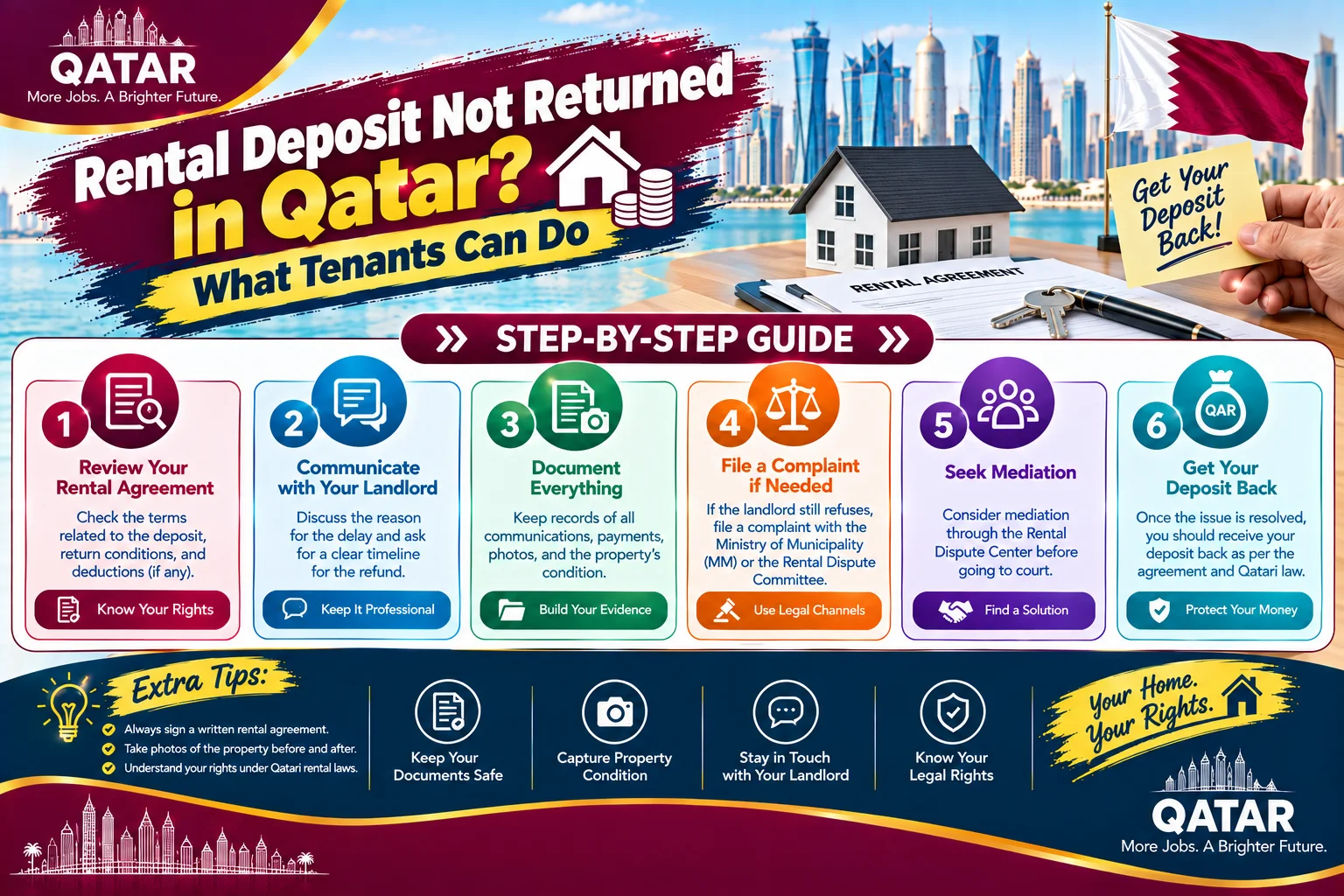
Rental Deposit Not Returned in Qatar? What Tenants Can Do
Landlord keeping your security deposit? Here is what the law generally allows, what changed on 3 September 2026, and the steps that get your money back.