
Bankruptcy in Qatar: Who Can Be Declared Bankrupt and What Happens
Under the Trading Regulation Law a trader who stops paying commercial debts can be declared bankrupt. Who can ask, what the bankrupt person loses, the travel restriction, the QR 100,000 small bankruptcy rule, the two-year rehabilitation and the penalties for fraud.

Bankruptcy in Qatar is a court process with serious personal consequences, and it applies to traders (and companies), not to every person in debt. This guide is based on the English text of Part 6 of the Trading Regulation Law (Law No. 27 of 2006) on Al Meezan, which we read in October 2026. Companies in the Qatar Financial Centre follow separate rules that we did not read, and the law may have been amended since. It is general information, not legal advice.
Who can be declared bankrupt
Article 606 applies to a trader who ceases to pay commercial debts. Using illegal means to pay debts counts as failure to pay and as evidence that the affairs are in trouble. Article 607 says a state of bankruptcy exists only once a court judgement declares it. Article 609 adds that a trader cannot be declared bankrupt for failure to pay criminal fines, taxes or fees of any kind.
Article 614 says a trader can be declared bankrupt even after death, after ceasing trade or after losing capacity, and that a declaration may be requested within two years of the trader's death or removal from the Commercial Register. Article 615 allows a trader based abroad to be declared bankrupt if they have a branch or agency in Qatar.
The articles we read do not define "trader" in detail. Our guides to business setup in Qatar and checking a company cover commercial registration.
Who can ask for bankruptcy
Article 608 says a trader may be declared bankrupt on a creditor's request, on their own request, or by the court on its own motion. Under Article 609:
- a creditor with a due, undisputed commercial debt can apply if it was not paid at maturity, even if the debt is guaranteed;
- a creditor with a deferred commercial debt can apply if the trader has no known domicile in Qatar, flees, closes the business, liquidates or takes steps that harm creditors, and the creditor proves the trader failed to pay a current commercial debt;
- a creditor for a due civil debt can apply if they prove the trader failed to pay current commercial debts.
Article 610 allows an urgent request by order on petition to the court president. Article 611 says a trader's own application is a report to the court registry giving the reasons, with the main commercial books, the latest balance sheet and profit and loss account, a statement of personal expenses for the previous two years, a detailed statement of property, a list of creditors and debtors with amounts, and a statement of protests for non-payment in the previous two years, all dated and signed.
What the bankrupt person loses
- **Control of property (Article 628):** the bankrupt may not dispose of or manage property after the judgement. It also covers assets that come to them afterwards, with exceptions for property that cannot be seized by law, maintenance amounts, personal status rights and insurance compensation (Article 629).
- **Public and commercial roles (Article 626):** an individual may not be a voter or member of the Shura Council, the Central Municipal Council or the Chamber of Commerce, or be a manager or director of a company. They may not engage in commerce, export, import, brokerage in securities or sale by auction, or represent others in managing their property. The court may let them manage their minor children's funds.
- **Movement (Article 627):** the bankrupt may not leave their domicile without the receiver's written permission. The receiver can, on their own or at the Public Prosecutor's request, place the bankrupt under supervision or prevent them from leaving the country for a renewable period. The bankrupt can ask for the decision to be reviewed.
- **Paying and collecting debts (Article 631):** the bankrupt may not pay debts or collect debts owed to them.
Small bankruptcy
Article 717 allows a simplified procedure when an inventory shows the bankrupt's property is worth no more than QR 100,000. Periods are shorter, no supervisor is appointed, a composition is enforceable immediately after the creditors approve, assets are distributed once, and the adjudicator's rulings cannot be appealed.
Getting your rights back (rehabilitation)
- **Two years (Article 780):** all rights are restored two years after bankruptcy ends, unless there is a fraudulent or negligent bankruptcy conviction. They are restored sooner if all debts including expenses are repaid.
- **Earlier in two cases (Article 781):** if the debtor obtains a composition with creditors and carries it out, or proves creditors have fully released them from all debts.
- **After a conviction (Article 782):** for fraudulent bankruptcy, rehabilitation is possible only three years after the sentence is served, pardoned or lapses, and for negligent bankruptcy only after the penalty is served, pardoned or lapses. In all cases the pre-bankruptcy debts must be paid or released.
- **Process (Articles 784 to 788):** apply to the court that declared the bankruptcy. The application is published in the Official Gazette and two local daily newspapers, the Public Prosecution reports within thirty days, creditors have thirty days to object, and a rejected application cannot be repeated on the same ground for six months.
Criminal penalties
Article 834 punishes a trader declared bankrupt who hid, destroyed or altered books, hid or disposed of property to defraud creditors, knowingly made or increased insolvency through false statements, or obtained a composition by fraud, with one to five years' imprisonment (fraudulent bankruptcy). Article 836 punishes negligent bankruptcy, such as spending huge amounts on personal expenses, not keeping adequate books, giving false data, favouring one creditor after stopping payments or selling goods below price to delay bankruptcy, with six months to three years. Articles 835 and 837 apply similar penalties to company directors and liquidators.
If you are owed money or owe money
1. Keep invoices, contracts, cheques and bank refusals. See bounced cheque in Qatar.
2. Keep proper books if you trade. Keeping inadequate books is one of the listed negligent acts.
3. Do not favour one creditor or move property once payments stop.
4. Get a Qatar-licensed lawyer before filing or answering a petition. A travel restriction can follow.
5. For employee salaries and gratuity when a business fails, see employer not paying salary and end of service gratuity.
What we could not verify
- Amendments to the Trading Regulation Law after the version we read, and any separate insolvency law.
- How an ordinary individual who is not a trader can deal with debt, and rules for the Qatar Financial Centre.
- How often courts apply the travel restriction in practice.
- The full text of the chapters on composition and administration of bankruptcy.
Frequently asked questions
Who can be declared bankrupt in Qatar?
Under Article 606 of the Trading Regulation Law, a trader whose financial affairs are in difficulty and who ceases to pay commercial debts. A state of bankruptcy exists only on a court judgement.
Can a bankrupt person leave Qatar?
Article 627 lets the receiver, or the Public Prosecutor, place the bankrupt under supervision or prevent them from leaving the country for a renewable period. The bankrupt can ask for a review.
How long until a bankrupt gets their rights back?
Article 780 restores rights two years after bankruptcy ends, unless there is a conviction for fraudulent or negligent bankruptcy, or sooner if all debts are repaid.
Can a person be declared bankrupt for unpaid taxes or fines?
No. Article 609 says a trader may not be declared bankrupt for failure to pay criminal fines, taxes or fees of any kind.
What is the penalty for fraudulent bankruptcy?
Article 834 sets imprisonment of one to five years for a trader declared bankrupt who commits listed acts such as hiding books or property to defraud creditors.
Sources & references

Agha Ali Abbas
Founder & Editor
More on Business
Explore everything you need to know about qatar business.
Related articles
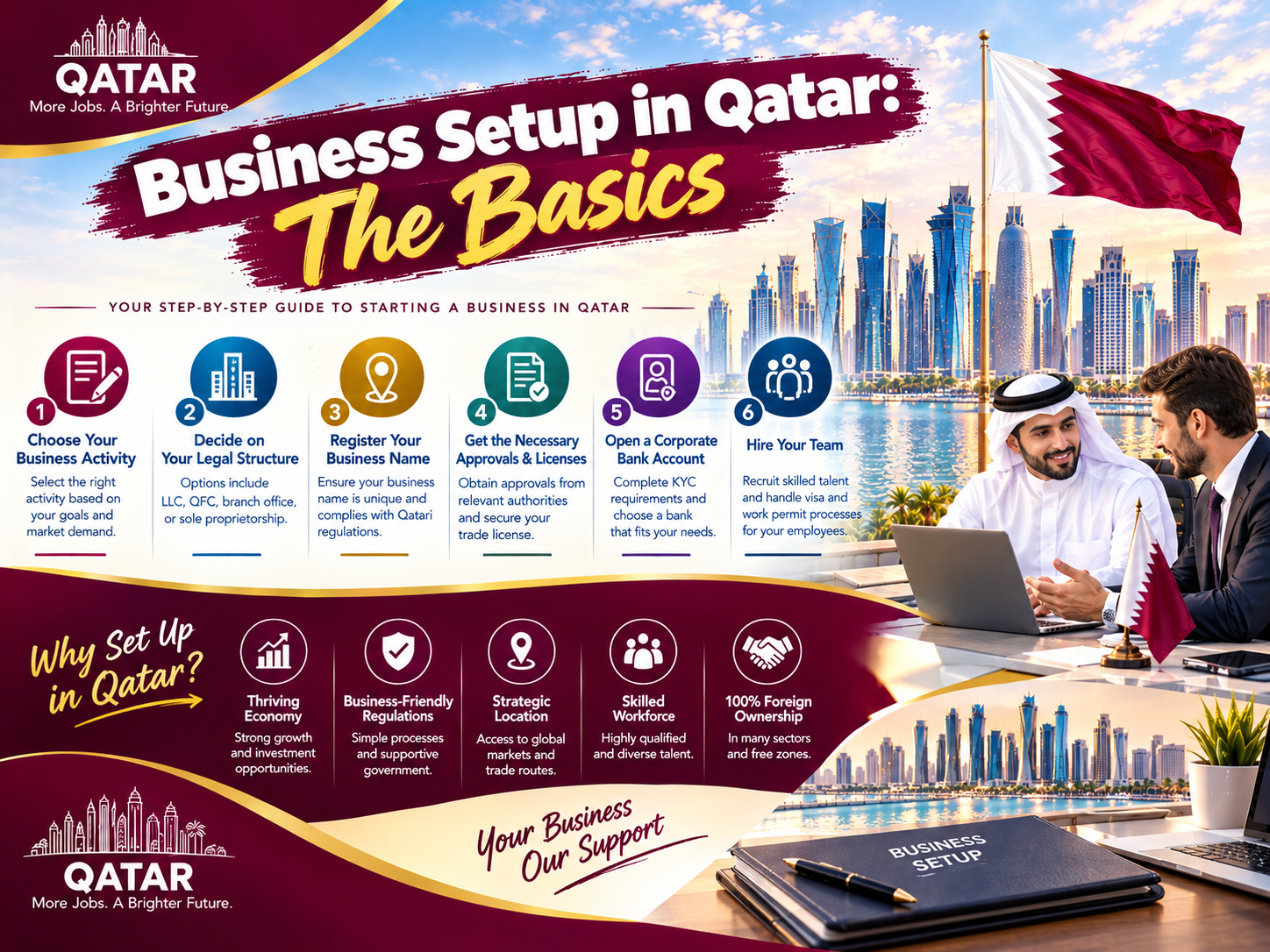
Business Setup in Qatar: The Basics
Mainland, free zone, or QFC: which structure actually fits your business, and the limitation most founders miss until it's too late.

An Overview of Qatar's Economy
Qatar's economy shrank 7.0 percent in the first quarter of 2026 as gas exports were hit, while the non-oil economy grew 3.5 percent. What that means and what to watch.
How to Check a Company in Qatar: CR Number, Trade License and Job Offer Scams
Before you accept a job offer, pay a fee or sign a deal in Qatar, check the company. What a commercial registration and trade license are, the official tools to use and the red flags to watch.