
What to Do If Your Employer Is Not Paying Your Salary in Qatar
Qatar's Wage Protection System is supposed to catch late salaries automatically. Here's what to do when it does not, and how to escalate if the delay continues.
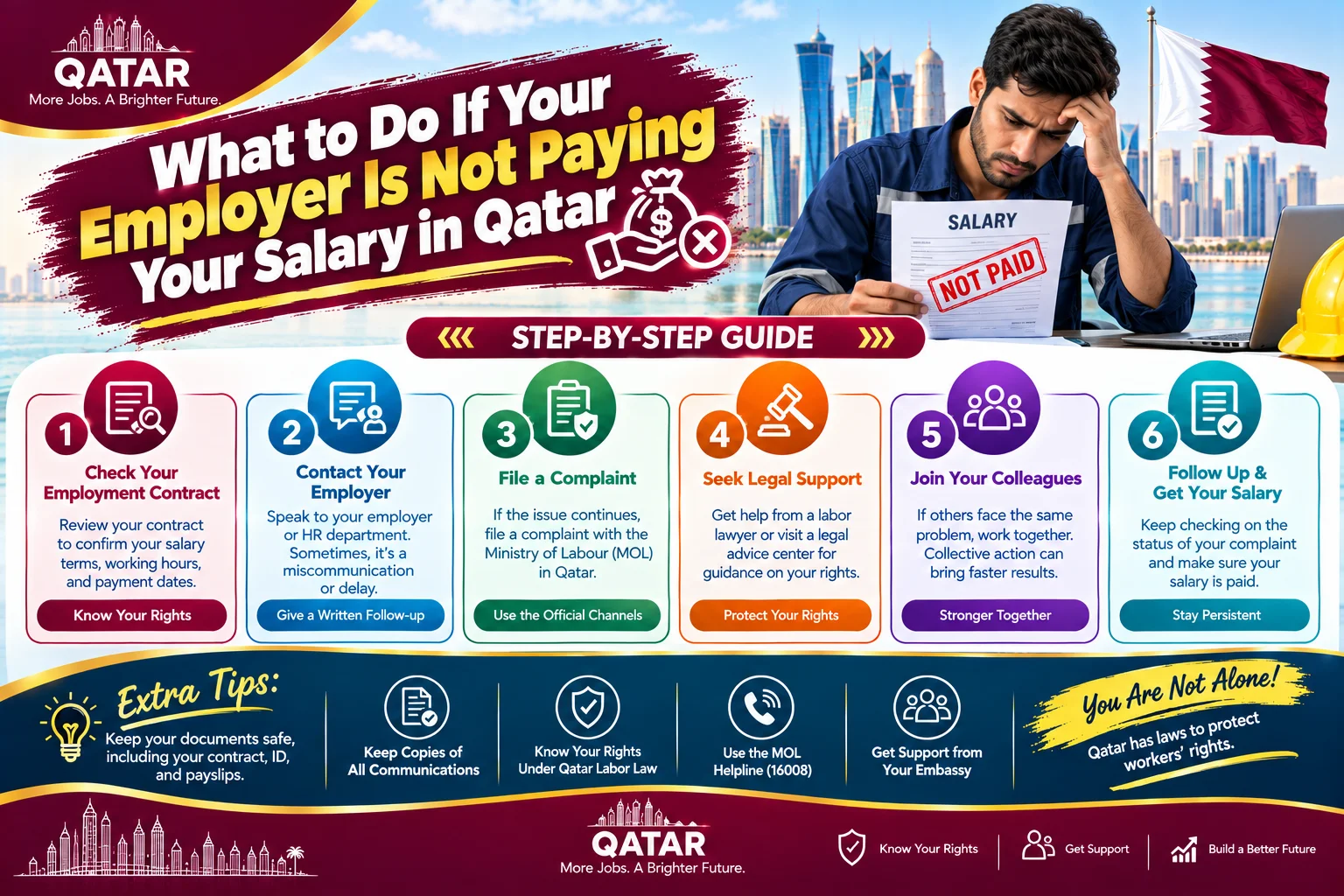
A late salary in Qatar is not something you have to quietly wait out. The system is built to flag it automatically, and there is a clear escalation path if your employer is not paying on time or in full. Here is what is actually happening behind the scenes, and what to do about it.
How the Wage Protection System is supposed to work
Most private-sector employers in Qatar are legally required to pay salaries through the Wage Protection System, which routes wages through banks and reports the transfers electronically to the Ministry of Labour. Under a September 2026 amendment, monthly wages are due on the first day of the calendar month and must be transferred within seven days of that date. If a payment is missing or short, the system is designed to flag it to the Ministry automatically, without you needing to report anything yourself. If the salary is only late rather than missing, our guide on what to do when your salary is delayed covers that case.
Why salaries still get missed despite the system
In practice, the system flags non-payment, but it does not put money in your account. If your company is genuinely struggling financially, is under investigation, or is simply slow to process the compliance side, you can still end up waiting past the deadline even though the violation has technically been logged. That is why filing your own complaint matters, it moves your specific case forward rather than waiting for a general enforcement action.
What to do the moment your salary is late
- Check your bank account and any payslip or salary certificate to confirm what you are actually owed and when it was due.
- Raise it with HR or payroll directly and in writing, so there is a dated record of when you first flagged it.
- If it is not resolved within a few days, file a complaint through the Ministry of Labour's complaints process. This can be done online, by SMS, by phone, or in person.
- Keep copies of your contract, past payslips, and any messages with your employer, since these become your evidence if the case moves to mediation.
What happens to a company that does not pay
Companies that repeatedly violate wage protection rules face real consequences: fines per infringement, restrictions on their ability to sponsor new work visas, and in serious or repeated cases, a block on their company transactions altogether. This is part of why filing matters even if you eventually get paid, unresolved patterns affect every worker at that company, not just you.
If you are considering leaving over unpaid salary
Persistent non-payment is one of the stronger grounds for leaving a job without the usual friction. If your employer has a documented pattern of late or missing salary, that context matters both for a labor complaint and if you decide to change employers. Keep your evidence organized either way.
What the Labour Law says about paying wages
Article 66 of Labour Law No. 14 of 2004, as shown on Al Meezan, which we read in October 2026, says monthly or annual wages must be paid at least once a month, and other workers at least once every two weeks. Wages may be paid to you personally or transferred to your bank account. The employer is discharged from the wage only if it actually transfers it to the bank, or you or your representative sign a receipt in the register or on a payslip that shows the details of the pay. That is why keeping payslips and bank statements matters.
Final pay when you leave (Article 67)
Article 67 says that when the contract ends, for whatever reason, the employer must pay your wage and all other dues before the end of the working day after the termination date. If you left without giving notice as Article 49 requires, the employer must pay within seven days of leaving the work. If you are owed a final settlement, including end-of-service gratuity, these are the timelines to quote in writing.
What reports say can happen to the employer
Law-firm and payroll summaries report penalties for failing to pay through WPS on time, including fines of QR 2,000 to 6,000 per employee and, in severe cases, imprisonment of up to one month for those responsible. They also report that the Ministry can suspend new work permits and its transactions with the employer until unpaid salaries are transferred. We have not confirmed these figures on an official page.
Can you change jobs if you are not paid
Qatar Tribune and Gulf Times reported on the Article 66 amendments that an employee can switch jobs without an employer NOC if wages are not paid within seven days of the due date. We did not find the amending text, so confirm with the Ministry before you resign or sign a new contract. Our guide to changing jobs without an NOC explains the wider rules, and our guide to delayed salaries covers the practical steps.
Common problems
- **HR says it is processing.** Ask for a written date. A vague promise with no date should still be treated as a missed deadline once the seven days pass.
- **Only part of the salary was paid.** Itemize what is missing against your contract and payslips, and raise it in writing.
- **You fear retaliation.** Keep messages professional and in writing, and keep your own copies of documents outside company systems.
What we could not verify
- The exact penalty amounts and when the Ministry applies them.
- The text of the amendment that reportedly allows a job change after seven days of non-payment.
- How long the Ministry's complaint process takes today.
Frequently asked questions
What is the Wage Protection System in Qatar?
It is a bank-based system that most private-sector employers must use to pay salaries, which electronically reports the transfer to the Ministry of Labour so missed or late payments are automatically flagged.
By what date should my salary arrive each month?
Under a September 2026 amendment to the Wage Protection System rules, monthly wages are due on the first day of the month and must be transferred within seven days of that date.
What should I do first if my salary is late?
Confirm the amount and due date against your contract, raise it with HR in writing, and if it is not resolved quickly, file a complaint with the Ministry of Labour.
Can my employer face penalties for not paying salaries on time?
Reports describe fines per infringement, restrictions on sponsoring new work visas, and in serious cases a block on the company's transactions, and one report mentions imprisonment under the 2026 amendments. We could not confirm the penalty details on an official page, so check with the Ministry of Labour.
Is filing a complaint over unpaid salary free?
Yes, filing through the Ministry of Labour's complaint channels is free and does not require a lawyer.
Sources & references

Agha Ali Abbas
Founder & Editor
More on Jobs
Explore everything you need to know about qatar jobs.
Related articles

How to Find a Job in Qatar: A Realistic Guide
Where roles actually get filled, what slows down the visa process, and how to avoid the mistakes that stall an offer.

In-Demand Jobs in Qatar: Sectors That Generally Hire Expats
The sectors that generally employ the most expats in Qatar, from healthcare and finance to tech and construction, with a note on how the 2026 gas disruption may affect energy hiring.
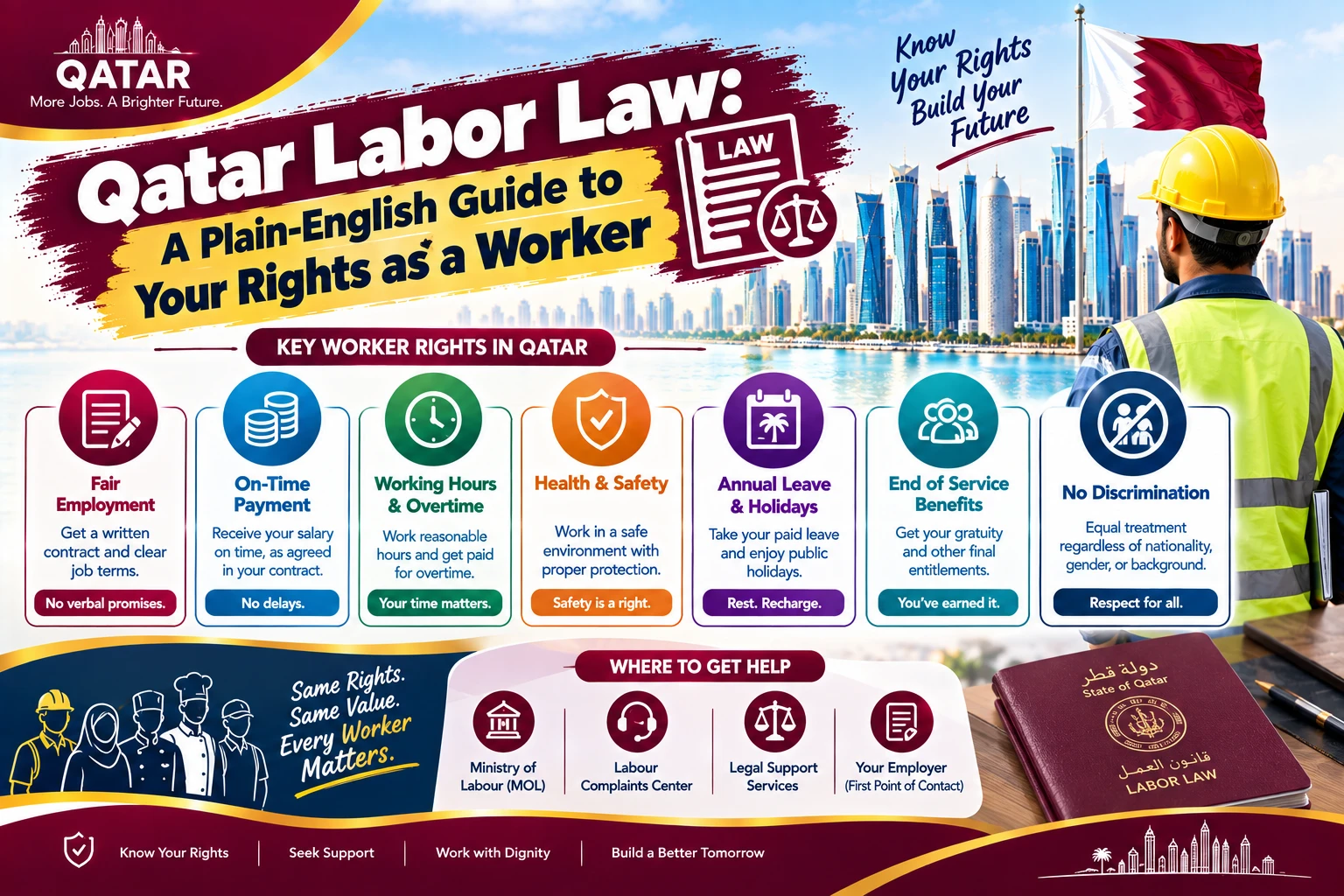
Qatar Labor Law: A Plain-English Guide to Your Rights as a Worker
What Qatar's labor law actually guarantees on hours, leave, overtime, and probation, explained without the legal jargon, plus where to go if your employer isn't following it.