
Overtime Pay and Working Hours in Qatar: What the Law Says
The legal weekly hours, the rate for overtime, night work and rest day work, and the roles the working hours rules do not cover, from Qatar's Labour Law.

Hours and overtime cause many pay disputes. This guide follows Articles 73 to 77 of Labour Law No. 14 of 2004 as shown on Al Meezan, Qatar's official legal portal, which we read in October 2026. It applies to workers under that law. Public sector staff, juveniles, and domestic workers have separate rules that we did not fully check.
Normal working hours (Article 73)
| Item | What Article 73 says |
|---|---|
| Weekly limit | 48 hours |
| Daily | 8 hours, all months except Ramadan |
| Ramadan | 36 hours a week, 6 hours a day |
| Travel to and from work | Not counted as working time |
| Intervals | One or more for prayer, rest and meals, between one and three hours, not counted as working time |
| Continuous work | Not more than five consecutive hours |
Because intervals are not counted, a day with an unpaid long break can run longer than eight hours on the clock. Article 73 also says a ministerial resolution can set work that needs to continue without a rest interval.
Overtime (Article 74)
Article 74 allows additional hours, but the actual working hours per day may not exceed ten, unless the work must continue to prevent a gross loss or dangerous accident, or to reduce its effects. The employer must pay for the additional hours at not less than the Basic Wage for ordinary hours plus an increase of at least 25%. Workers who work between 9 pm and 6 am, except shift workers, must be paid the Basic Wage plus an increase of at least 50%.
An example
This is our own illustration, not an official calculation. If your basic wage works out to QR 10 an hour, overtime on an ordinary day should be at least QR 12.50 an hour, and work between 9 pm and 6 am should be at least QR 15 an hour. The law does not give a formula for converting a monthly wage into an hourly one, so ask HR how it does this.
The weekly rest day (Article 75)
Article 75 says a worker gets a paid weekly rest of at least 24 consecutive hours, and Friday is the usual rest day for all workers except shift workers. If the work needs you on your rest day, the employer must give you another day instead, and pay what is due for work on the rest day, or the Basic Wage plus an increase of at least 150%. That is at least 2.5 times the basic wage for those hours. Except for shift workers, you cannot be employed on two consecutive Fridays.
Who the rules do not cover (Article 76)
Article 76 says Articles 73, 74 and 75 do not apply to persons in senior positions that give them the employer's authority over workers. Article 73 also does not apply to workers who do preparatory or complementary work before or after working hours, to guards and cleaners, and to other categories set by the Minister, with a ministerial order setting their maximum hours. If you are in one of these groups, ask HR which rule sets your hours.
The timetable must be posted (Article 77)
Article 77 requires the employer to post, at the main entrances and in a visible place, a table showing the closure or weekly rest day, the working hours and the rest intervals for each category, and to give the Department a copy.
Summer outdoor work
Outdoor work has an additional summer rule, covered in our guide to the midday work ban.
What to do
This is our own practical advice, not part of the law.
- Keep your own record of the hours you work, with dates and start and finish times.
- Check whether your payslip shows overtime separately and whether the rate is at least the legal minimum.
- Ask HR in writing how the hourly rate is calculated.
- If overtime is unpaid, see our guide on employer not paying salary and our guide to filing a labor complaint.
- For the wider rules on leave and probation, see our Qatar labor law guide.
Common mistakes
- Treating travel time to work as paid working time. Article 73 excludes it.
- Assuming meal and prayer intervals count as working hours. They do not.
- Forgetting the higher rate for work between 9 pm and 6 am.
- Not asking for a replacement day after working on a rest day.
What we could not verify
- Whether ministerial orders have changed the hours for guards, cleaners and other categories under Article 76.
- How employers convert monthly pay into an hourly rate. The articles do not set a formula.
- Whether later amendments changed Articles 73 to 77. Al Meezan showed the 2005 text with no amendment notice when we read it.
Related: see weekly rest day and public holidays in Qatar for rest day work and holiday pay.
Frequently asked questions
How many hours a week can you work in Qatar?
Article 73 sets 48 ordinary hours a week, at 8 a day, and 36 a week at 6 a day in Ramadan. Overtime can take actual daily hours up to 10 under Article 74.
How is overtime paid in Qatar?
Article 74 says at least the Basic Wage for ordinary hours plus an increase of at least 25%. Work between 9 pm and 6 am, except for shift workers, is paid at least the Basic Wage plus 50%.
What is the pay for working on Friday in Qatar?
Article 75 says if you work on your weekly rest day you get another day off and the pay due for the rest day, or the Basic Wage plus an increase of at least 150%.
Do break times count as working hours?
No. Article 73 says the intervals for prayer, rest and meals, between one and three hours, are not counted as working hours. Travel to and from work is also not counted.
Who is not covered by the working hours rules?
Article 76 excludes senior positions with employer authority from Articles 73 to 75, and excludes guards, cleaners and some other categories from Article 73. A ministerial order sets their hours.
Sources & references

Agha Ali Abbas
Founder & Editor
More on Jobs
Explore everything you need to know about qatar jobs.
Related articles

How to Find a Job in Qatar: A Realistic Guide
Where roles actually get filled, what slows down the visa process, and how to avoid the mistakes that stall an offer.

In-Demand Jobs in Qatar: Sectors That Generally Hire Expats
The sectors that generally employ the most expats in Qatar, from healthcare and finance to tech and construction, with a note on how the 2026 gas disruption may affect energy hiring.
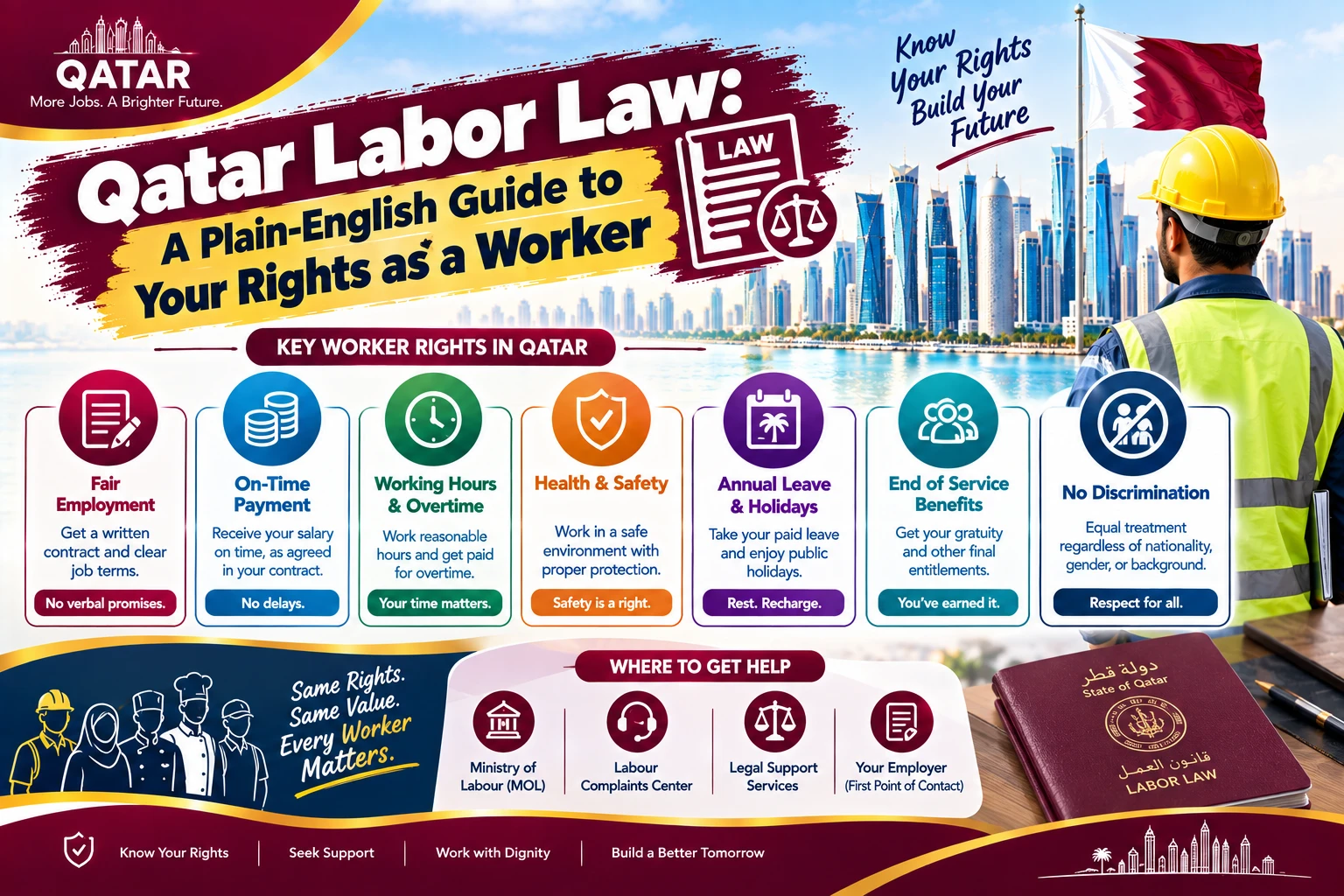
Qatar Labor Law: A Plain-English Guide to Your Rights as a Worker
What Qatar's labor law actually guarantees on hours, leave, overtime, and probation, explained without the legal jargon, plus where to go if your employer isn't following it.