
Qatar Labor Law: A Plain-English Guide to Your Rights as a Worker
What Qatar's labor law actually guarantees on hours, leave, overtime, and probation, explained without the legal jargon, plus where to go if your employer isn't following it.
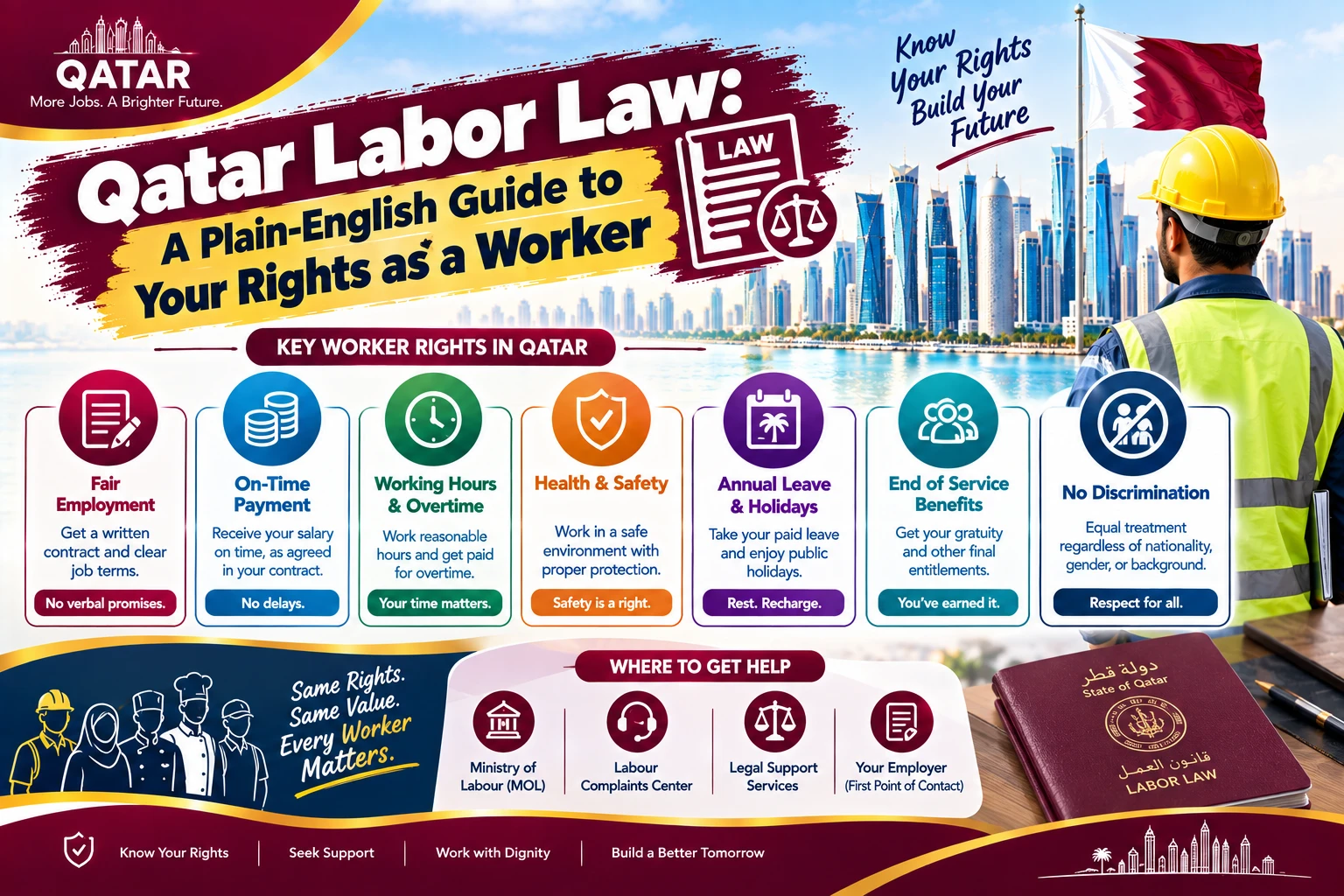
Most of what people in Qatar know about labor law comes from a coworker's story, not the text of the law. That gap causes real problems. This guide was rewritten in September 2026 from the articles themselves, which we read on Al Meezan, Qatar's official legal portal. Al Meezan lists Law No. 14 of 2004 as in force. The government said in 2020 that Decree Law No. 18 of 2020 amended some provisions, so check Al Meezan for the latest wording before you rely on a detail in a dispute.
Working hours (Article 73)
The maximum ordinary working hours are 48 a week, at 8 a day, throughout the year, except in Ramadan, when the maximum is 36 a week, at 6 a day. Article 73 does not limit the Ramadan reduction to Muslim workers. It applies to workers generally, so an employer cannot rely on religion to keep you on full hours.
| Period | Maximum ordinary hours |
|---|---|
| Most of the year | 8 a day, 48 a week |
| Ramadan | 6 a day, 36 a week |
Time you spend travelling between home and work is not counted as working hours. Article 77 requires the employer to post a table at the entrance and in a visible place at work showing the weekly rest day, working hours, and rest intervals for each category of worker.
Breaks during the day (Article 73)
Working hours must include one or more intervals for prayer, rest, and meals, of not less than one hour and not more than three hours in total. Those intervals are not counted as working hours, so they are not paid time. A worker cannot be made to work more than five consecutive hours. Many people assume the meal break is paid, but the article says otherwise.
Overtime and night work (Article 74)
A worker may work more than the ordinary hours, but actual working hours cannot exceed 10 a day, unless continuing the work is needed to prevent serious loss or a dangerous accident or to limit its effects. The employer must pay for additional hours at not less than the basic wage plus at least 25 percent of it, which is where the 125 percent figure comes from.
The article also says that, apart from shift workers, workers who work between 9 pm and 6 am must be paid the basic wage plus an increase of at least 50 percent. If your employer treats extra hours as unpaid, that is not what the article says, and it is a common issue raised through the labor complaint process. For worked rates and exclusions, see our guide to overtime pay and working hours.
Weekly rest day (Article 75)
A worker is entitled to a paid weekly rest of at least 24 consecutive hours, and Friday is the usual rest day for everyone except shift workers. If the work requires you to work on your rest day, you must be given another day in compensation, and paid what is payable for a rest day, or the basic wage plus an increment of at least 150 percent. Summaries usually say 150 percent, but the wording adds an increment of at least 150 percent to the basic wage, so ask the Ministry of Labour how the payment is calculated for you. Outside shift work, you cannot be made to work two consecutive Fridays.
Who these limits do not cover (Article 76)
Articles 73, 74, and 75 do not apply to people in senior positions who hold the employer's authority over workers. Article 73's hours limits also do not apply to workers doing preparatory or complementary work before or after working hours, or to guarding and cleaning workers, or to other categories the Minister specifies. In those cases, the Minister sets the maximum hours. If you fall into one of these groups, your limits may differ, so ask HR which rule applies to you.
Public holidays (Article 78)
The article entitles a worker each year to leave with full remuneration for three working days at Eid Al-Fitr, three at Eid Al-Adha, one for Independence Day, and three working days specified by the employer. If the work requires you to work on those days, Article 75 applies, meaning compensation and the higher payment described above. Official public holiday dates are set separately each year, so check the current calendar.
Annual leave (Articles 79 to 81)
A worker who has completed a continuous whole year of service is entitled to paid annual leave of not less than three weeks for employment of less than five years, and four weeks for five years or more, with leave for part-years in proportion to service. The employer decides the timing based on work needs, and may split the leave with your consent into no more than two periods. On your written request, the employer may postpone not more than half of the leave to the next year.
You cannot waive the right to annual leave, and any agreement to the contrary is void. If your contract ends for any reason before you take the leave, you are entitled to a cash alternative equal to your pay for the leave days due. See our full guide to annual leave in Qatar.
Sick leave (Article 82)
Sick leave with pay is available after three months from the date you first started work, and you must prove the illness with a medical report from the physician approved by your employer. Full pay applies if the sick leave does not exceed two weeks. If it continues, you receive half pay for the next four weeks. After that it is unpaid until you return, resign, or are terminated for health reasons.
Your service may be terminated at the end of the twelfth week if a licensed physician's report shows you cannot resume work. These rules do not affect your end of service gratuity, and the twelve weeks are not treated as an interruption of continuous service. See our guide to end of service gratuity, and our full guide to sick leave in Qatar.
Probation (Article 39)
A contract may include a probation period agreed by both sides. It cannot exceed six months from the start of work, and an employer cannot put a worker on probation with the same employer more than once. The article says an employer may end the contract before probation expires if the worker fails to carry out their duties, and must notify the worker of the decision within at least three days from the termination date. See our full guide to probation in Qatar.
Getting paid
For limits on what an employer can take from your pay, see salary deductions in Qatar. Salary payment problems are covered in our guides to an employer not paying salary and salary delayed in Qatar. For the legal floor on pay, see our guide to the Qatar minimum wage, and to check what your employer registered, see how to check your employment contract online. If you are changing employers, see our guide to changing jobs without an NOC.
Where to get help
For dismissal and notice, see our guide to termination rules. For pregnancy rights, see maternity leave in Qatar, and for safety, see workplace safety in Qatar. For work injuries, see injured at work in Qatar. For the full holiday picture, see Qatar public holidays. If your employer is not following these rules, our guide to how to file a labor complaint in Qatar explains the process. Some groups, such as domestic workers, follow separate rules that we did not check here.
What we could not verify
- Whether any of the articles above was amended after 2020, since Al Meezan's page did not show us amendment details.
- The rule on probation notice periods for the worker, and whether moving employers during probation needs your current employer's consent. An earlier version of this page stated these, and we could not confirm them from the article text, so we removed them.
- How the Ministry of Labour calculates pay for work on the rest day in practice.
- The current official public holiday calendar, which is set separately.
- The rules for domestic workers and public sector employees.
For deeper single-topic guides, see disciplinary penalties, job duty changes, non-compete clauses, recruitment fees, and return ticket and service certificate.
Related: how to check a company in Qatar and commercial registration renewal in Qatar.
Frequently asked questions
What is the maximum number of working hours allowed in Qatar?
Article 73 sets 8 hours a day and 48 a week, and 6 a day and 36 a week in Ramadan. With overtime, Article 74 caps actual hours at 10 a day, except in emergencies.
Are working hours shorter in Ramadan for everyone in Qatar?
Article 73 sets the Ramadan maximum at 36 hours a week, 6 a day, without limiting it to Muslim workers.
How is overtime paid in Qatar?
Article 74 says not less than the basic wage plus at least 25 percent, and for work between 9 pm and 6 am, apart from shift workers, the basic wage plus at least 50 percent.
How much annual leave am I entitled to in Qatar?
After a continuous whole year, at least three weeks for under five years of service and four weeks for five years or more, with part-years in proportion. Article 81 says you cannot waive it.
Can my employer keep me on probation more than once?
No. Article 39 limits probation to six months and bars probation with the same employer more than once.
How does sick leave work in Qatar?
After three months of service and with a medical report, Article 82 gives full pay for up to two weeks, then half pay for four weeks, then unpaid leave.
Sources & references
- Al Meezan, Law No. 14 of 2004, Article 73, working hours (checked Sep 2026)
- Al Meezan, Law No. 14 of 2004, Article 74, overtime (checked Sep 2026)
- Al Meezan, Law No. 14 of 2004, Article 75, weekly rest (checked Sep 2026)
- Al Meezan, Law No. 14 of 2004, Articles 78 to 82, holidays, leave, sick leave (checked Sep 2026)
- Al Meezan, Law No. 14 of 2004, Article 39, probation (checked Sep 2026)
- Government Communications Office, statement on labour law amendments (30 Aug 2020)

Agha Ali Abbas
Founder & Editor
More on Jobs
Explore everything you need to know about qatar jobs.
Related articles
How to Find a Job in Qatar: A Realistic Guide
Where roles actually get filled, what slows down the visa process, and how to avoid the mistakes that stall an offer.

In-Demand Jobs in Qatar: Sectors That Generally Hire Expats
The sectors that generally employ the most expats in Qatar, from healthcare and finance to tech and construction, with a note on how the 2026 gas disruption may affect energy hiring.
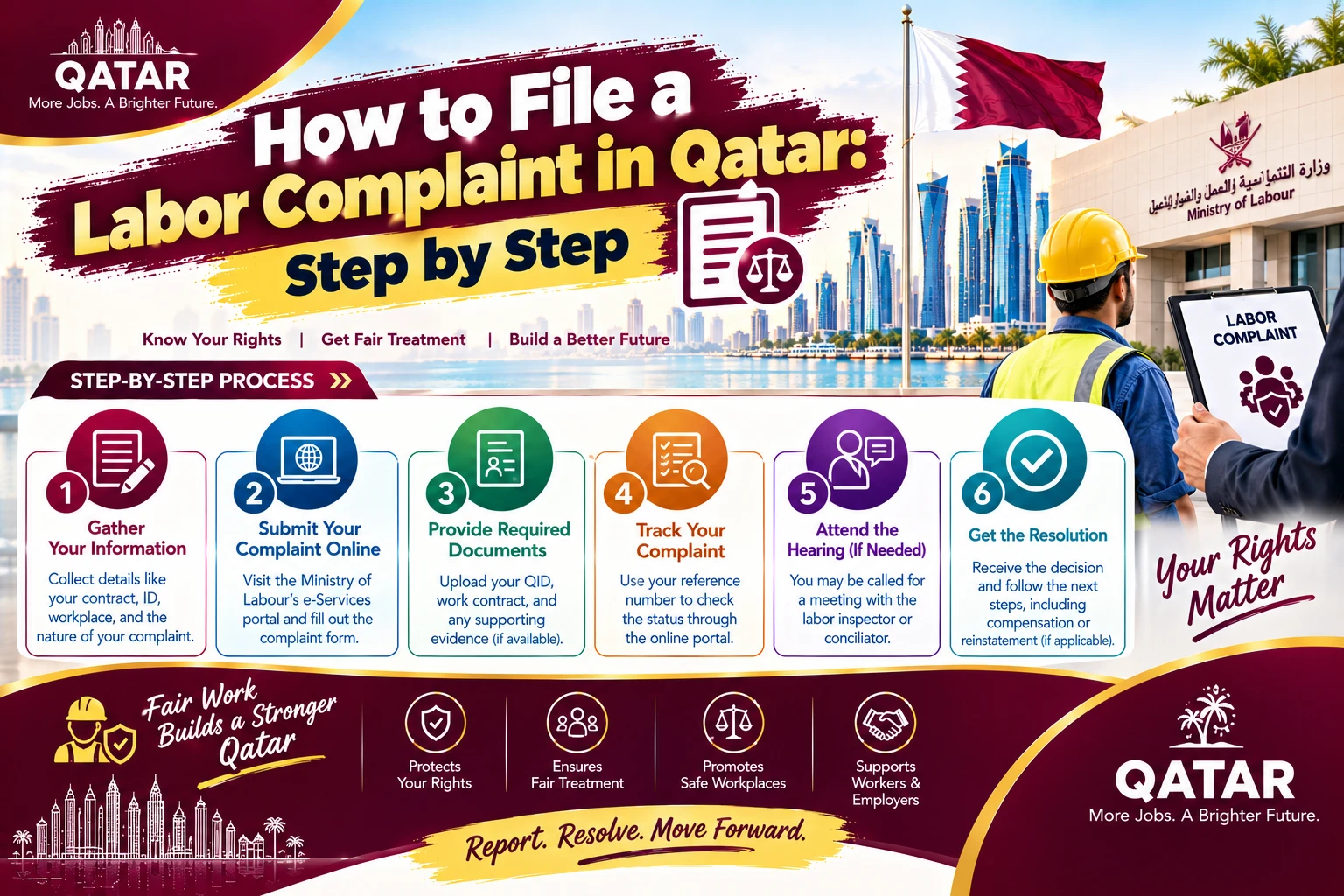
How to File a Labor Complaint in Qatar: Step by Step
Exactly how to report unpaid wages, contract violations, or unsafe conditions to Qatar's Ministry of Labour, and what happens after you file.