
Working Under 18 in Qatar: What the Labour Law Allows
Minimum age, parental consent, medical checks, shorter hours and the night and holiday ban for juveniles under Qatar's Labour Law, and what employers must record.

Teenagers and their parents ask when a young person can work in Qatar and on what terms. This guide follows Articles 86 to 92 of Labour Law No. 14 of 2004 as shown on Al Meezan, Qatar's official legal portal, which we read in October 2026. The law uses the word juvenile and our guide does the same.
Minimum age
Article 86 says a juvenile who has not reached sixteen may not be employed in work of any nature and may not be permitted to enter any workplace.
Consent and permission
Article 87 (as amended in 2009) says a juvenile may not be employed without the consent of the father or guardian and a special permission issued by the Department. A Qatari student also needs the approval of the Minister of Education and Higher Education. Juveniles may not be put in work whose nature or circumstances could harm health, safety or morals, with such work set by a ministerial order.
Medical checks
Article 88 says a juvenile must be medically examined by the competent medical authority and confirmed fit before starting, and the employer must repeat the examination at least once a year.
Hours and rest
- Article 89: no work between sunset and sunrise, on rest days or official holidays, or beyond normal hours, and no more than seven consecutive hours at the workplace.
- Article 90: ordinary hours of up to 36 a week at six a day, and in Ramadan up to 24 a week at four a day. Travel time is not counted as working hours. There must be rest and meal intervals, and no more than three consecutive hours of work. Intervals are not counted as working hours.
What the employer must keep and report
Article 91 says the employer must keep the juvenile's birth certificate, health fitness certificate and periodic medical reports, signed by the employer, in a special file. Article 92 requires an employer of any juvenile to give the Department a statement with the juvenile's name, work and date of employment, and to post a clear notice of working hours and rest intervals in a conspicuous place.
If you are a parent or a young person
This is our own advice, not part of the law.
- Ask for the employer's written permission details from the Department before the first day.
- Keep copies of your birth certificate and medical certificate.
- Compare the hours you are given against Articles 89 and 90. Our overtime and working hours guide covers the adult limits for comparison.
- If rules are broken, see how to file a labor complaint.
Common mistakes
- Starting work before the medical check.
- Assuming school holiday work has no rules.
- Agreeing to evening or rest day shifts that Article 89 bars.
What we could not verify
- The current list of prohibited hazardous work, which is set by a ministerial order we did not read.
- The Department's current permit process and how a family applies.
- Whether other laws on child work or education apply, and whether later amendments changed Articles 86 to 92.
- How these articles apply to domestic work, public sector or free zones.
Frequently asked questions
What is the minimum working age in Qatar?
Article 86 says a juvenile who has not reached sixteen may not be employed in any work or enter a workplace.
Does a teenager need permission to work?
Article 87 requires the father or guardian's consent and a special permission from the Department.
How many hours can a juvenile work?
Article 90 sets up to 36 hours a week at six a day, and 24 a week at four a day in Ramadan, with no more than three consecutive hours of work.
Can a juvenile work at night?
No. Article 89 bars work between sunset and sunrise, on rest days and on official holidays.
Is a medical check required?
Yes. Article 88 requires a fitness examination before starting and again at least once a year.
Sources & references

Agha Ali Abbas
Founder & Editor
More on Jobs
Explore everything you need to know about qatar jobs.
Related articles
How to Find a Job in Qatar: A Realistic Guide
Where roles actually get filled, what slows down the visa process, and how to avoid the mistakes that stall an offer.

In-Demand Jobs in Qatar: Sectors That Generally Hire Expats
The sectors that generally employ the most expats in Qatar, from healthcare and finance to tech and construction, with a note on how the 2026 gas disruption may affect energy hiring.
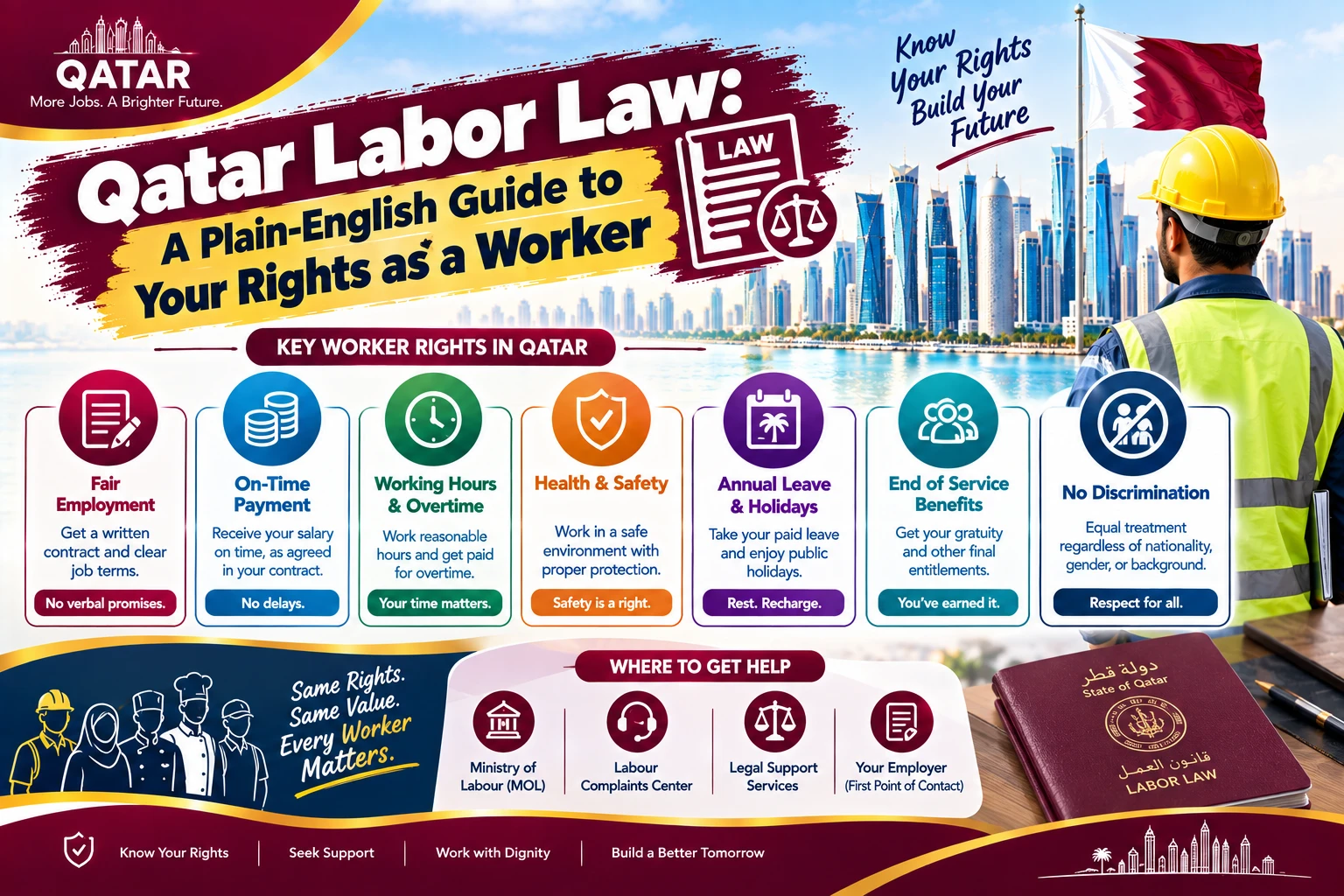
Qatar Labor Law: A Plain-English Guide to Your Rights as a Worker
What Qatar's labor law actually guarantees on hours, leave, overtime, and probation, explained without the legal jargon, plus where to go if your employer isn't following it.