
Disciplinary Penalties at Work in Qatar: What Employers Can Impose
The penalties Qatar's Labour Law allows, the cap on pay deductions, the rules an employer must follow before punishing you, and how to object within seven days.

Fines, suspensions, and warnings at work are a common source of disputes. This guide follows Articles 58 to 64 of Labour Law No. 14 of 2004 as shown on Al Meezan, Qatar's official legal portal, which we read in October 2026. It covers workers under that law. For dismissal without notice, see our separate guide to whether your employer can fire you. For deductions from pay unrelated to penalties, see salary deductions in Qatar.
Penalty rules must exist and be posted
Article 58 says an employer with ten or more workers must set penalty rules listing the violations and the penalties for each. The rules are submitted to the Department and are deemed approved if there is no objection within a month. They must be posted at the workplace, and they come into force fifteen days after publication. Article 62 adds that a penalty cannot be imposed for an act not stated in the penalty rules.
The penalties the law lists
Article 59 lists the disciplinary penalties an employer may impose.
| Penalty in Article 59 | Limit |
|---|---|
| Written notice | A letter naming the violation and warning of a severer penalty if repeated |
| Deduction from pay | Not more than five days for one violation |
| Suspension without pay | Not more than five days for one violation |
| Suspension pending a criminal charge | Treated as never happened, with pay due, if you are acquitted or the charge is dropped |
| Postponed annual increment | Not more than six months, where an increment system exists |
| Postponed promotion | Not more than one year, where a promotion system exists |
| Dismissal with gratuity | Retains the right to end-of-service gratuity |
| Dismissal without gratuity | Gratuity is not paid |
Article 60 adds a monthly cap: deductions for penalties cannot reduce your pay by more than five days' remuneration per month. The employer must record each penalty in a register that the labour inspection authority can inspect.
What the employer must do first
Article 62 sets the process. The employer cannot accuse you of a violation more than fifteen days after becoming aware of it, except for criminal offences. You can only be penalized for a violation directly related to work. You must be informed of the accusation and investigated in writing before a penalty, though the investigation can be oral for minor violations that carry only a notice or a one-day deduction, and the report must be filed. Only one penalty can be imposed for a single violation, and only the employer, an authorized representative, or the manager can impose it.
Article 63 says you must be notified of the penalty in writing. If you refuse to receive it, it is posted at the workplace. If you are absent, it is sent by registered letter to your permanent address in your file.
How to object: the seven-day steps
Article 64 sets a short timeline. First, file a grievance with the employer within seven days of being told of the penalty. The employer must decide within seven days, and silence counts as refusal. Next, if it is refused, you may file a claim with the Department within seven days, and the Department decides within seven days. Its decision is conclusive, and silence counts as refusal. For a penalty of dismissal, you may object before the competent court. If the court finds the dismissal arbitrary or against the law, it can cancel it and return you to work with pay for the suspension period, or award appropriate compensation.
What to do
This is our own practical advice, not part of the law.
- Ask HR for the written penalty rules, and check whether the act you are accused of is listed.
- Respond in writing and keep dated copies, because every step in Article 64 runs on days.
- Count the days from the date you were told, and file the grievance before the seven days end.
- For wider complaints, see our guide to filing a labor complaint.
Common mistakes
- Waiting to see whether the penalty is real, and missing the seven-day grievance window.
- Accepting a deduction larger than five days' pay.
- Signing an admission without seeing the accusation in writing.
- Not asking whether the employer has approved penalty rules.
What we could not verify
- Whether later amendments or ministerial decisions changed Articles 58 to 64. Al Meezan showed the 2005 text with no amendment notice when we read them.
- How the Ministry of Labour handles these claims today, including whether the Department's review is still described the same way.
- How these rules apply to employers with fewer than ten workers, public sector staff, or domestic workers.
Frequently asked questions
How much can my employer deduct as a penalty in Qatar?
Article 59 limits a deduction to five days for one violation, and Article 60 says deductions cannot reduce your pay by more than five days' remuneration per month.
Can my employer punish me without an investigation?
Article 62 says you must be informed of the accusation and investigated in writing before a penalty. The investigation may be oral for minor violations, but the report must be recorded and filed.
How long do I have to object to a penalty?
Article 64 gives you seven days from being informed to file a grievance with the employer.
Can an employer penalize me for something not in the rules?
Article 62 says a penalty may not be inflicted for an act not stated in the penalties rules.
Can I challenge a dismissal penalty in court?
Article 64 says you may object to a dismissal penalty before the competent court, which can cancel it and reinstate you with pay or award compensation.
Sources & references

Agha Ali Abbas
Founder & Editor
More on Jobs
Explore everything you need to know about qatar jobs.
Related articles

How to Find a Job in Qatar: A Realistic Guide
Where roles actually get filled, what slows down the visa process, and how to avoid the mistakes that stall an offer.

In-Demand Jobs in Qatar: Sectors That Generally Hire Expats
The sectors that generally employ the most expats in Qatar, from healthcare and finance to tech and construction, with a note on how the 2026 gas disruption may affect energy hiring.
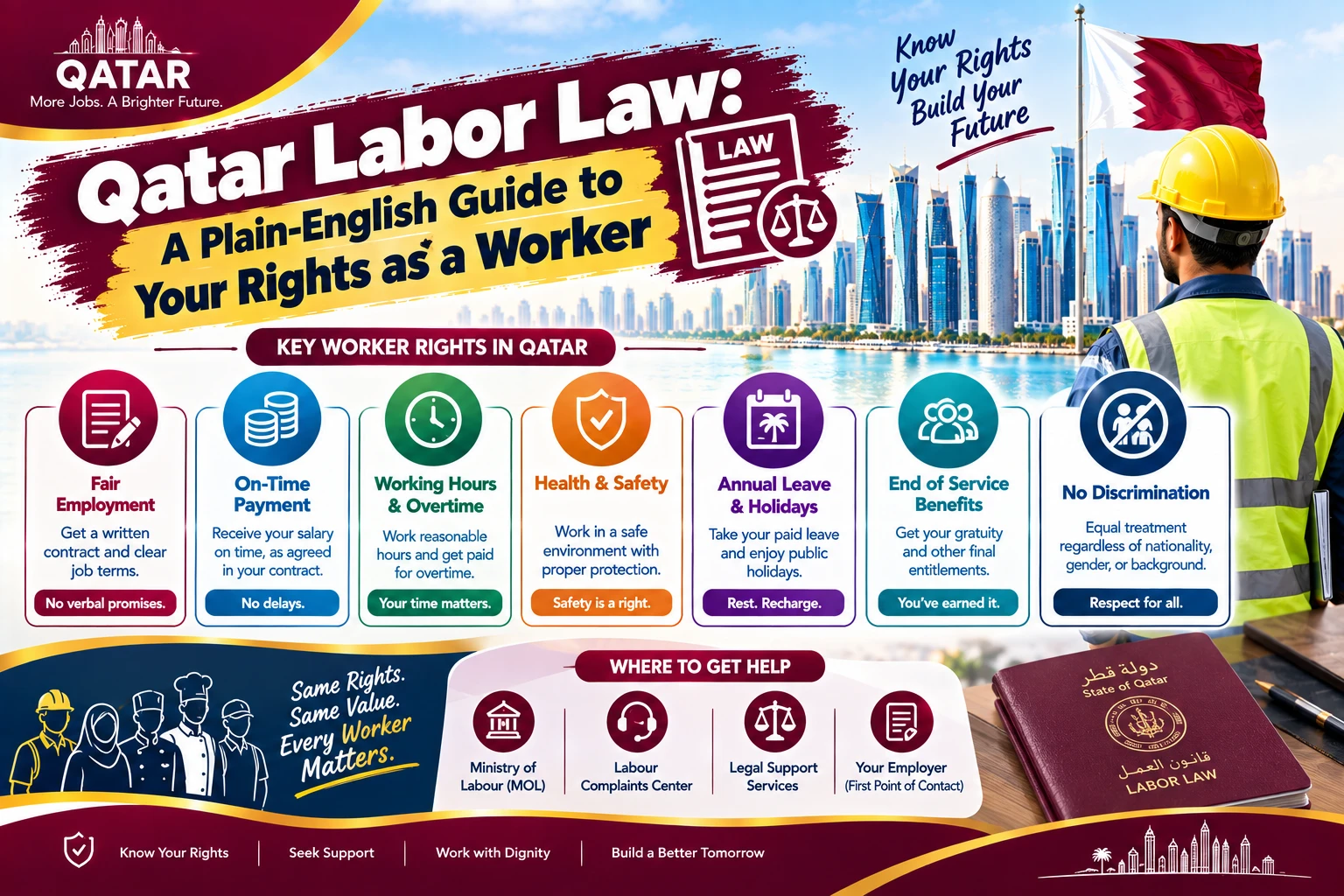
Qatar Labor Law: A Plain-English Guide to Your Rights as a Worker
What Qatar's labor law actually guarantees on hours, leave, overtime, and probation, explained without the legal jargon, plus where to go if your employer isn't following it.