
Can My Employer Fire Me in Qatar? Termination and Notice Rules
What Qatar's Labour Law says on notice periods, when an employer can dismiss without notice or gratuity, when a worker can leave and keep gratuity, and how to object to a dismissal.

Dismissal is one of the most stressful workplace events, and the rules are spread across several articles of the Labour Law. This guide follows the text of those articles as shown on Al Meezan, Qatar's official legal portal. Al Meezan lists the law as in force, but the government said Decree Law No. 18 of 2020 amended some provisions, so confirm current wording for your case with the Ministry of Labour.
Notice when either side ends the contract (Article 49)
Article 49 says either party may end an employment contract without giving reasons, provided the interested party notifies the other in writing. The English text on Al Meezan refers to a contract for a fixed period, while many summaries apply these rules to contracts of unlimited duration, so ask the Ministry of Labour which category yours falls into.
| Worker paid | Service | Minimum written notice |
|---|---|---|
| Monthly or annually | Five years or less | One month |
| Monthly or annually | More than five years | At least two months |
| Other cases | Under one year | At least one week |
| Other cases | One to five years | At least two weeks |
| Other cases | Five years or more | At least one month |
If the notice period is not respected, the party ending the contract must compensate the other with an amount equal to the full remuneration for the notice period or the remaining part of it.
Pay during notice (Article 50)
Article 50 says the employer must pay the worker full remuneration for the notice period if the worker performs the work in the usual manner during it. It also says the employer must give a Qatari worker reasonable time off to register for a new job, which applies to Qatari workers, so it is not a general right for expats.
When you can leave and keep your gratuity (Article 51)
Article 51 says a worker may end a fixed-term contract before its expiry without giving reasons. For an unlimited contract, the worker may end it and keep the full right to end of service gratuity in these cases:
- The employer breaches obligations under the contract or the Labour Law.
- The worker or one of their family members suffers physical assault or an immoral act from the employer or the manager.
- The employer or their representative misled the worker about the terms and conditions of the employment when contracting.
- A gross danger threatens the worker's health and safety, the employer knows of it, and does not act to remove it.
See our guide to end of service gratuity for how gratuity is calculated.
When an employer can dismiss without notice or gratuity (Article 61)
Article 61 says the employer may dismiss a worker without notice and without paying end of service gratuity in these cases:
- The worker assumes a false identity, claims a false nationality, or submits false certificates or documents.
- The worker commits a mistake that causes gross financial loss, and the employer notifies the Department within 24 hours of becoming aware of it.
- The worker violates written safety instructions more than once, despite written notification, where the instructions were written and posted in a conspicuous place.
- The worker fails more than once to carry out essential duties under the contract or the law, despite written notification.
- The worker discloses the establishment's secrets.
- The worker is found in a clear state of drunkenness or under the influence of a drug during working hours.
- The worker assaults the employer, manager, or a supervisor in the workplace during the working day or because of it.
- The worker repeats an assault on colleagues despite a written warning.
- The worker is absent without a legitimate cause for more than seven consecutive days or fifteen interrupted days in a year.
- The worker is convicted by a final judgment of a crime of dishonour or dishonesty.
This is a list of the cases in the article. Whether a case applies to you is a question of facts, and the article sets conditions such as written warnings, so a dismissal that skips them is worth challenging.
Objecting to a penalty or dismissal (Article 64)
Article 64 sets a sequence for objecting to a penalty:
1. File a grievance with the employer within seven days of being informed. The employer must decide within seven days, and silence counts as refusal.
2. If it is refused, or there is no decision, file a claim with the Department within seven days of the refusal.
3. The Department decides within seven days, and its decision is conclusive, though silence again counts as refusal.
The article makes an exception for dismissal: the worker may object to dismissal before the competent court. If the court finds the dismissal arbitrary or in violation of the law, it may cancel the dismissal and return the worker to work with the entitlements for the suspension period, or award appropriate compensation that includes remuneration and privileges for that period. The article does not state a time limit for going to court, and we did not find one, so seek advice quickly.
What to do if you are dismissed
This is our own practical advice, not part of the law.
- Ask for the reason and the notice in writing, and keep every message.
- Check the date and whether the notice period the article requires was respected.
- Compare the reason with the Article 61 list, since that list decides whether gratuity is lost.
- Note the seven-day steps in Article 64 and act immediately if you object.
- Check your registered contract, using our guide to checking your employment contract online.
- If salary or gratuity is unpaid, see our guides to an employer not paying salary and filing a labor complaint.
- If your residence will end, see our guide to what happens when a residence permit expires and to changing jobs without an NOC.
Common mistakes
- Resigning or signing a document without understanding the notice and gratuity effects.
- Missing the seven-day steps in Article 64.
- Assuming every dismissal loses gratuity, when Article 61 lists the cases.
- Assuming the Qatari-only job-search time off in Article 50 applies to expats.
What we could not verify
- Whether the 2020 amendments changed the notice or dismissal articles.
- Which contract type the Article 49 notice periods apply to in practice.
- A time limit for taking a dismissal to court.
- How compensation for arbitrary dismissal is calculated.
Related guides on what happens around dismissal and the end of a contract: disciplinary penalties at work and return ticket and service certificate.
Related: leaving without notice has its own risks. See absconding cases in Qatar.
Frequently asked questions
How much notice must an employer give in Qatar?
Article 49 says monthly or annually paid workers get one month if service is five years or less and at least two months if more than five years, with shorter periods in other cases.
Can an employer dismiss me without notice in Qatar?
Article 61 lists ten cases, such as false documents, repeated breaches after written warnings, or absence for more than seven consecutive days without a legitimate cause. In those cases there is also no end of service gratuity.
Can I leave my job and still get gratuity?
For an unlimited contract, Article 51 says yes in cases such as the employer breaching the contract or the law, physical assault, being misled at contracting, or a known gross danger to health and safety.
How do I object to being dismissed in Qatar?
Article 64 says a worker may object to a dismissal before the competent court, and that the court can cancel it and reinstate the worker or award compensation if it was arbitrary or unlawful.
What happens if notice is not given?
Article 49 says the party ending the contract must compensate the other with the full remuneration for the notice period or the remaining part of it.
Sources & references
- Al Meezan, Law No. 14 of 2004, Article 49, notice (checked Sep 2026)
- Al Meezan, Law No. 14 of 2004, Article 51, worker termination (checked Sep 2026)
- Al Meezan, Law No. 14 of 2004, Article 61, dismissal without notice (checked Sep 2026)
- Al Meezan, Law No. 14 of 2004, Article 64, grievances and dismissal (checked Sep 2026)

Agha Ali Abbas
Founder & Editor
More on Jobs
Explore everything you need to know about qatar jobs.
Related articles

How to Find a Job in Qatar: A Realistic Guide
Where roles actually get filled, what slows down the visa process, and how to avoid the mistakes that stall an offer.

In-Demand Jobs in Qatar: Sectors That Generally Hire Expats
The sectors that generally employ the most expats in Qatar, from healthcare and finance to tech and construction, with a note on how the 2026 gas disruption may affect energy hiring.
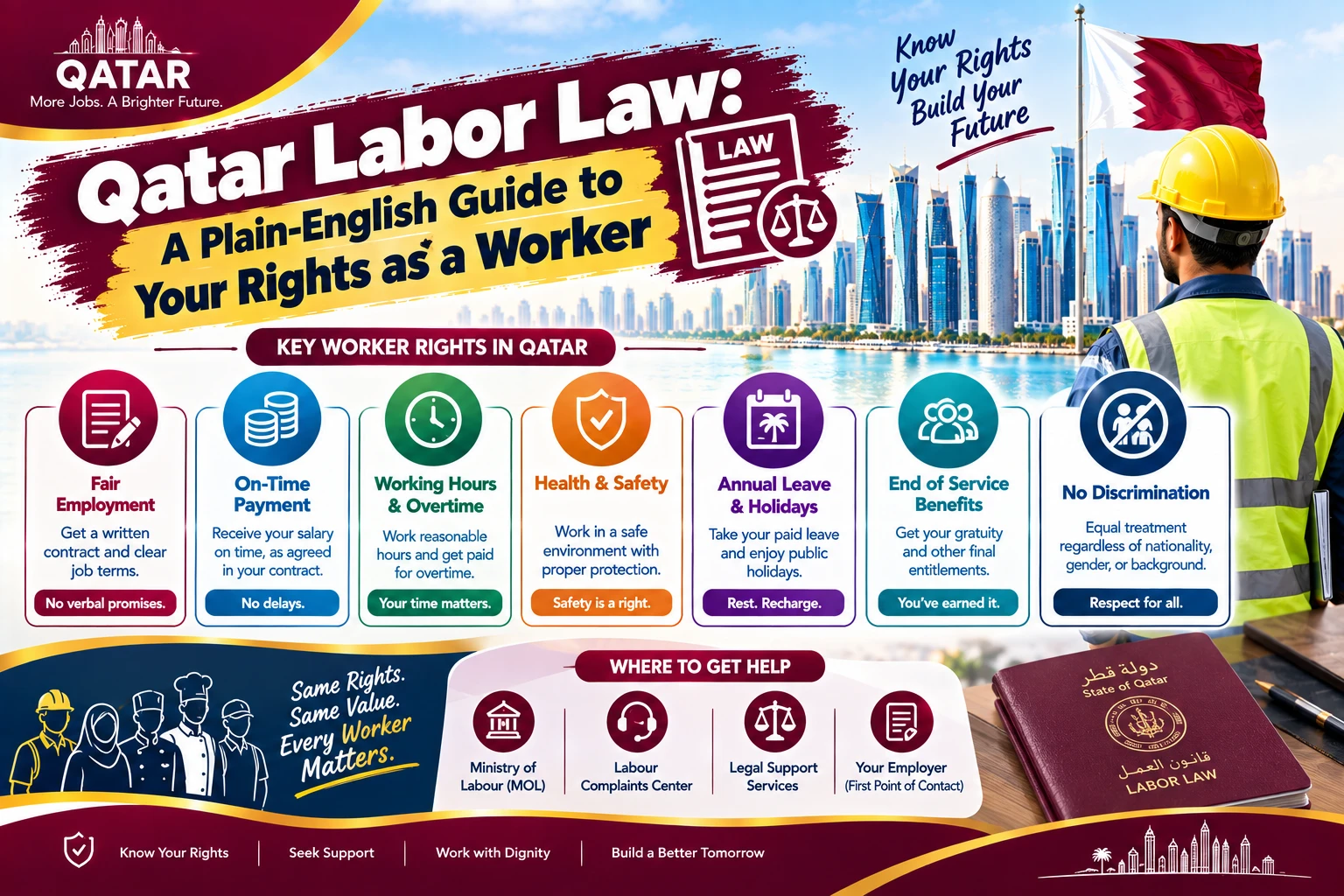
Qatar Labor Law: A Plain-English Guide to Your Rights as a Worker
What Qatar's labor law actually guarantees on hours, leave, overtime, and probation, explained without the legal jargon, plus where to go if your employer isn't following it.