
Employer Housing, Transport and Water at Remote Work Sites in Qatar
Article 106 requires employers at remote sites to provide transport or accommodation, drinking water and food access. What it says, who it applies to, and what we could not confirm about housing generally.

Many workers ask whether the employer has to provide housing. The Labour Law has a specific rule for remote sites and a general one for larger employers. This guide follows Articles 106 and 107 of Labour Law No. 14 of 2004 as shown on Al Meezan, Qatar's official legal portal, which we read in October 2026. It does not say every employer must provide housing, and we say what we could not check.
What Article 106 requires
Employers employing workers in places distant from the cities, to which normal means of transport do not reach, must provide three things.
- Suitable means of transportation or suitable accommodation or both.
- Potable water.
- A suitable food supply or the means of obtaining it.

Which places count
Article 106 says such places are determined by an order from the Minister. We did not read that order, so we cannot list which sites it covers. If you work at a distant site, ask the Ministry whether it is on the list.
Social services for larger employers
Article 107 says an employer of fifty or more workers must provide the social services specified by a decision of the Minister, taking into account the location of the work, circumstances and number of workers. The article does not name the services, and we did not read the decision.
What this does not say
Article 106 is about remote places. It does not say that every employer must house every worker. Whether housing or an allowance is owed to you depends on your contract and any ministerial decisions we did not check, so read your contract first. See also our workplace safety guide for the duties on safe working conditions.
If your site lacks water, food access or transport
This is our own advice, not part of the law.
- Note the location, dates and what was missing, with photos where safe.
- Raise it with your employer in writing first.
- If nothing changes, see how to file a labor complaint.
- In summer heat also see the midday work ban rules.
Common mistakes
- Assuming Article 106 covers every site. It applies to places the Minister's order sets.
- Accepting a lack of drinking water as normal.
- Not keeping any record of conditions.
What we could not verify
- The ministerial order listing the remote places, and the decision listing Article 107 social services.
- Any separate rules on worker accommodation standards or housing allowances.
- Whether later amendments changed Articles 106 and 107, and how they apply to domestic workers, public sector staff or free zones.
Frequently asked questions
Must my employer provide housing in Qatar?
Article 106 requires suitable transport or accommodation or both at remote sites set by ministerial order. We did not find a general article requiring housing for every worker.
Is drinking water required?
At the remote places Article 106 covers, yes. The employer must provide potable water.
What is Article 107?
It requires employers of fifty or more workers to provide social services specified by a ministerial decision.
Who decides which sites are remote?
Article 106 says such places are determined by an order from the Minister.
Sources & references

Agha Ali Abbas
Founder & Editor
More on Jobs
Explore everything you need to know about qatar jobs.
Related articles

How to Find a Job in Qatar: A Realistic Guide
Where roles actually get filled, what slows down the visa process, and how to avoid the mistakes that stall an offer.

In-Demand Jobs in Qatar: Sectors That Generally Hire Expats
The sectors that generally employ the most expats in Qatar, from healthcare and finance to tech and construction, with a note on how the 2026 gas disruption may affect energy hiring.
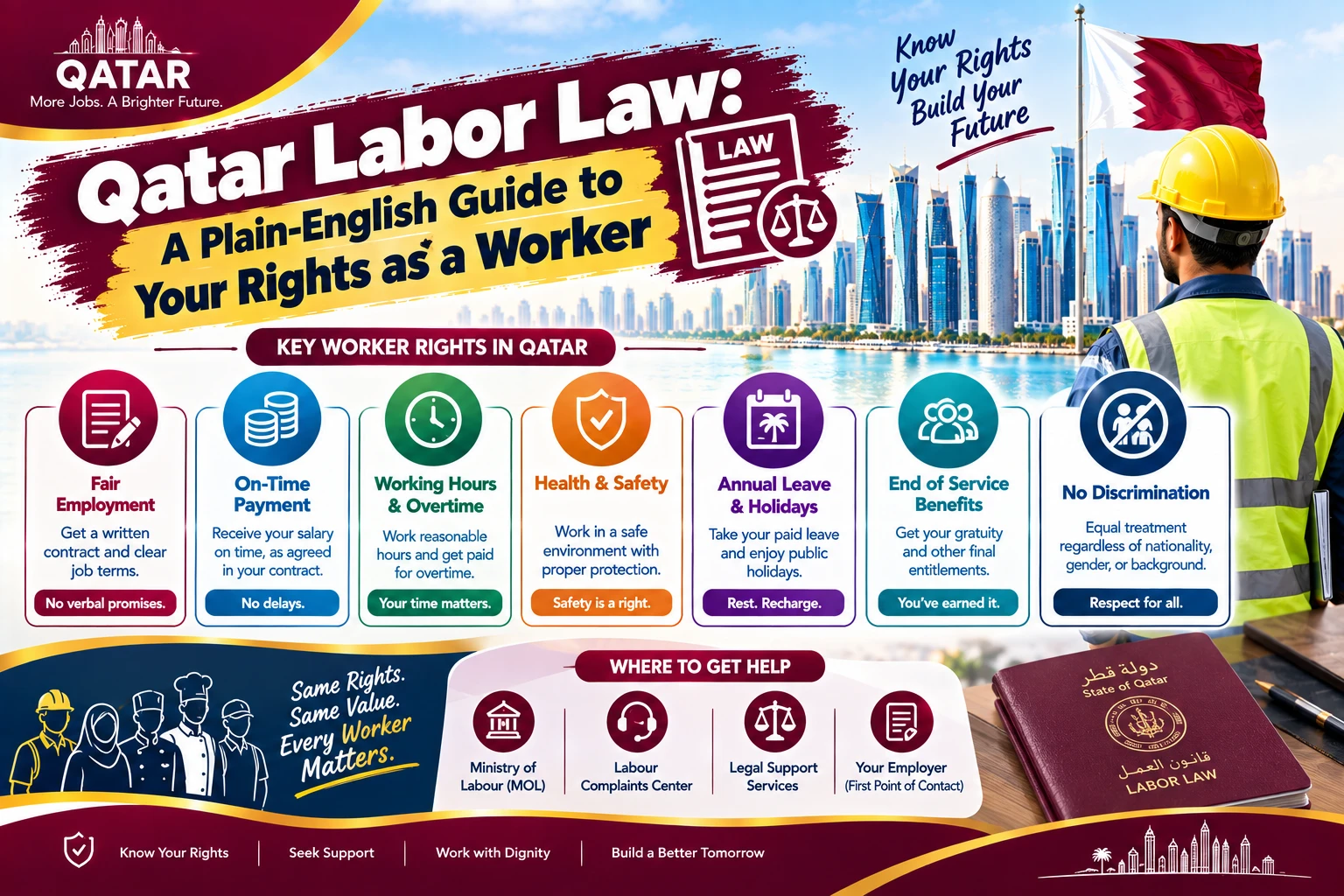
Qatar Labor Law: A Plain-English Guide to Your Rights as a Worker
What Qatar's labor law actually guarantees on hours, leave, overtime, and probation, explained without the legal jargon, plus where to go if your employer isn't following it.