
Injured at Work in Qatar: Your Rights and Compensation
What the Labour Law says an employer must do after a work injury: report it, pay for treatment, pay your remuneration, and compensate disability or death, plus the limits and deadlines.
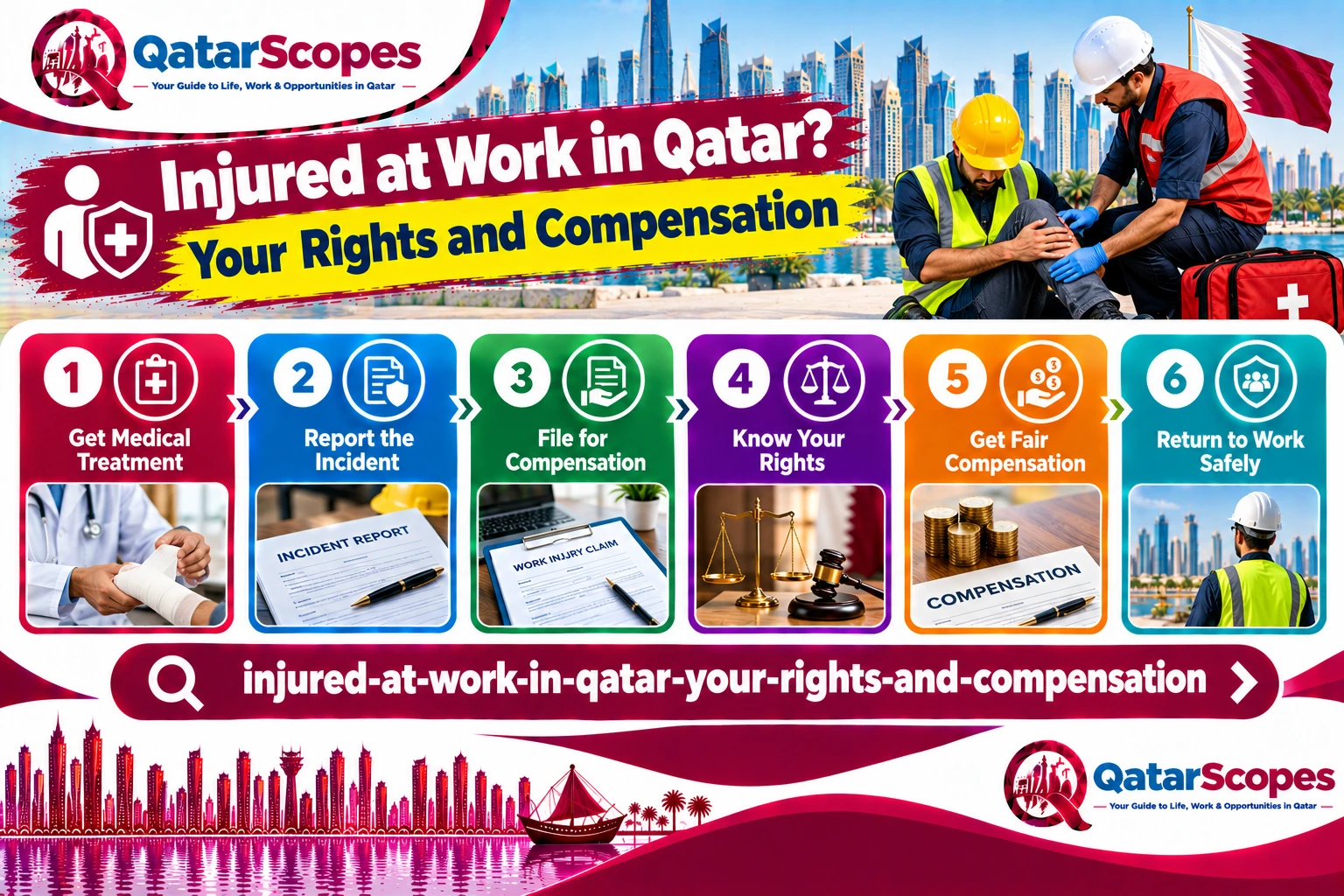
Work injuries are covered by a specific chapter of Labour Law No. 14 of 2004, Articles 108 to 115. This guide follows those articles as shown on Al Meezan, and Hukoomi's employer reporting service. We read both in September 2026. The law may have been amended since it was passed, so confirm details with the Ministry of Labour.
The employer must report the injury (Article 108)
Article 108 says that if a worker dies during the work or because of it, or suffers an occupational injury, the employer or their representative must report it immediately to the police and to the Department. The report includes the worker's name, age, profession, address, nationality, a brief description of the accident and its circumstances, and the aid or treatment given. The police then investigate, take statements from witnesses, the employer, and the injured worker if their condition allows, and clarify the relation of the accident to the work.
Hukoomi describes an online Ministry of Labour service for this. It lets companies and establishments subject to the Labour Law immediately report work injuries to the Labor Inspection Department, by logging in with the establishment ID, QID card, and mobile numbers, and it is free. It is an employer service, so a worker cannot use it. The Ministry of Labour hotline listed by Hukoomi is 16505 or 44068979.
Treatment and pay during treatment (Article 109)
Article 109 says a worker who sustains an occupational injury has the right to treatment appropriate to their situation at the employer's cost, according to the decision of the competent medical authority. The worker receives full remuneration throughout the treatment or for six months, whichever is less. If treatment lasts more than six months, the worker receives half remuneration until cure or permanent incapacity is established, whichever comes first.
Compensation for disability or death (Article 110)
Article 110 says a worker who suffers an occupational injury resulting in whole or partial disability has the right to compensation, and so do the heirs of a worker who dies because of the work. For death, the amount is calculated under Islamic law. A permanent whole disability is treated as death. Partial disability is a proportion of the whole set out in Schedule 2 to the law, and compensation is calculated on that proportion. We did not find a fixed amount in the articles we read, so we do not publish one.
When the rights do not apply (Article 111)
Article 111 says Articles 109 and 110 do not apply if it is proved that:
- The worker harmed themselves intentionally.
- The worker was under the influence of a drug or drunk, and that was the cause of the injury or death.
- The worker intentionally violated the employer's occupational health and safety instructions, or committed gross negligence in following them.
- The worker, without a genuine reason, refused a medical examination or did not follow the treatment prescribed.
The article says these must be proved, so a bare accusation is not enough.
Disputes about fitness and treatment (Article 112)
If the employer and the worker dispute whether the worker can return to work, or any other medical question about the injury, disease, or treatment, Article 112 says the Department refers it to the competent medical authority, whose decision on matters within its jurisdiction is conclusive.
Deadlines and payment (Articles 113 and 114)
Article 113 says the right to claim compensation for disability or death expires one year after the final medical report that records the disability, after confirmation that the disability resulted from a listed occupational disease, or after the date of death. Do not wait for the last day. Article 114 says the employer must pay disability compensation within fifteen days of the disability being proved or of the result of inquiries supporting that it was caused by the work. In the case of death, the employer must deposit the compensation with the competent court within fifteen days.
What to do after an injury
This is our own practical advice, not part of the law.
- Get medical treatment first and tell your supervisor immediately.
- Ask that the accident be reported, and ask for a copy of the report, since the law puts the duty on the employer.
- Keep your medical reports, and note the date of the final medical report, because it starts the one-year clock in Article 113.
- Keep records of your pay during treatment, and compare them with Article 109.
- If your employer does not report, treat, or pay, use our guide to filing a labor complaint and the Ministry of Labour hotline.
- Check your health card and insurance arrangements. See our guide to the healthcare system in Qatar.
For your wider rights on hours and leave, see our Qatar labor law guide.
Common mistakes
- Not asking for the accident report, then struggling to prove it was work-related.
- Waiting past the one-year claim period in Article 113.
- Refusing a medical examination or treatment without a genuine reason, which Article 111 lists as a case where the rights do not apply.
- Signing a settlement without understanding the disability percentage.
What we could not verify
- Whether the 2020 amendments or later changes altered these articles.
- The compensation amounts in the schedules, and how the Ministry of Labour applies them.
- How work injuries interact with health insurance and any workers' compensation scheme.
- Any procedure for a worker to report an injury directly, since Hukoomi's service is for employers.
Frequently asked questions
Who pays for treatment after a work injury in Qatar?
Article 109 says the worker is entitled to appropriate treatment at the cost of the employer, according to the decision of the competent medical authority.
Do I still get paid if I am injured at work in Qatar?
Article 109 says full remuneration throughout treatment or for six months, whichever is less, then half remuneration until cure or permanent incapacity.
Who reports a work injury in Qatar?
Article 108 says the employer or their representative must report it immediately to the police and the Labour Department. Hukoomi's online service for this is for employers.
How long do I have to claim work injury compensation?
Article 113 says the right expires one year after the final medical report recording the disability, or after the date of death.
When can I lose the right to compensation?
Article 111 lists intentional self-harm, injury caused by drunkenness or drugs, intentional violation of safety instructions or gross negligence, and refusing medical examination or treatment without a genuine reason, if proved.
Sources & references

Agha Ali Abbas
Founder & Editor
More on Jobs
Explore everything you need to know about qatar jobs.
Related articles
How to Find a Job in Qatar: A Realistic Guide
Where roles actually get filled, what slows down the visa process, and how to avoid the mistakes that stall an offer.

In-Demand Jobs in Qatar: Sectors That Generally Hire Expats
The sectors that generally employ the most expats in Qatar, from healthcare and finance to tech and construction, with a note on how the 2026 gas disruption may affect energy hiring.
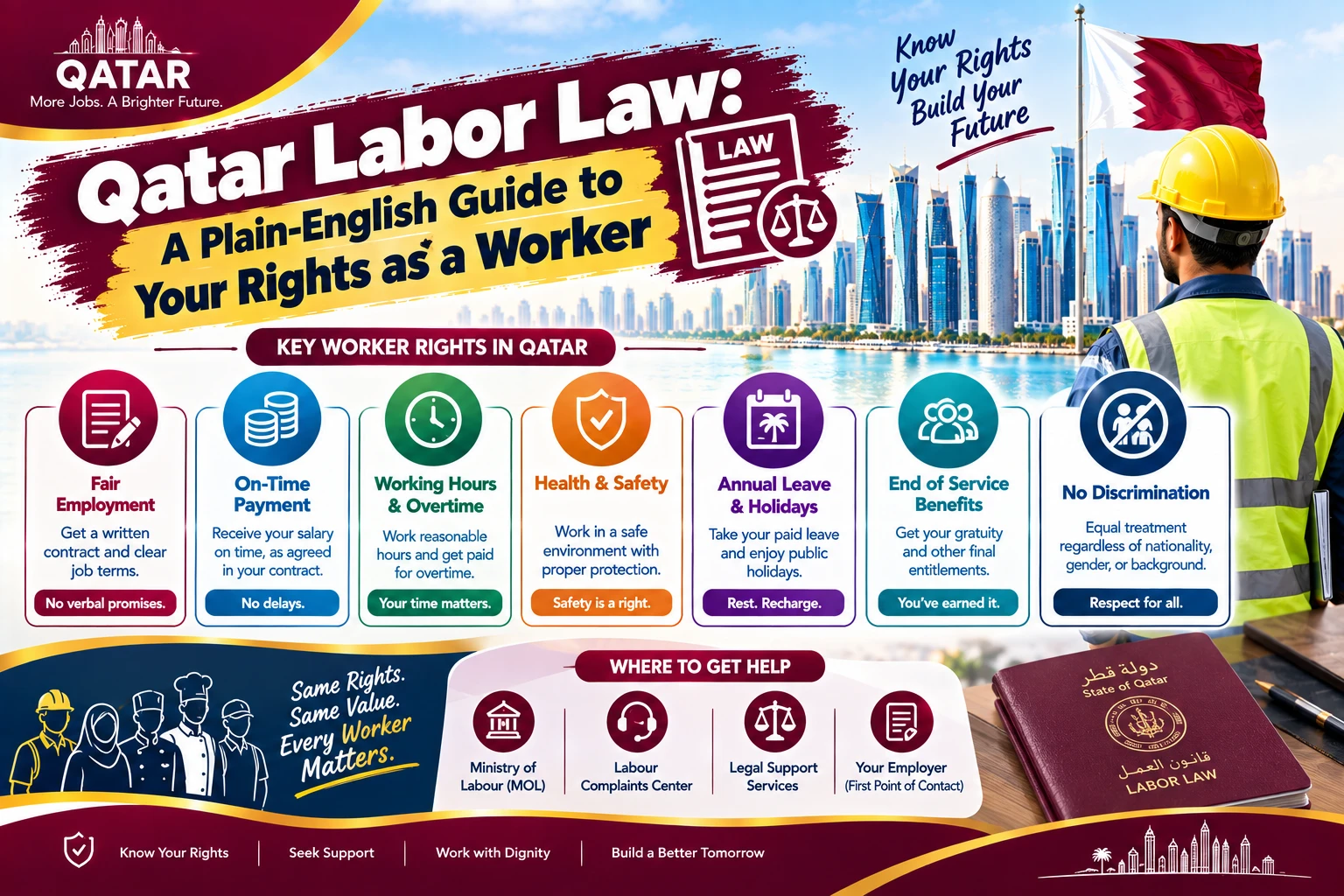
Qatar Labor Law: A Plain-English Guide to Your Rights as a Worker
What Qatar's labor law actually guarantees on hours, leave, overtime, and probation, explained without the legal jargon, plus where to go if your employer isn't following it.