
Domestic Worker Rights in Qatar: Hours, Rest, Leave, Pay and Gratuity
Law No. 15 of 2017 sets a written contract, a ten-hour day, a weekly rest day, three weeks of leave and an end of service payment for domestic workers. What each article says.

Domestic workers, such as maids, drivers, nannies, cooks and gardeners, are covered by their own law rather than the main Labour Law. This guide follows the Arabic text of Law No. 15 of 2017 and Law No. 17 of 2020 as shown on Al Meezan, Qatar's official legal portal, which we read in October 2026. We translated the articles ourselves. Both laws are marked as in force on the portal.
Who the law covers
Article 1 defines a domestic worker as a natural person who does household work under the management and supervision of the employer for pay, such as a driver, a nanny, a cook or a gardener, and those like them. The employer must also be a natural person. If you employ a worker through a company, a different set of rules may apply.
The written contract
Article 3 says a domestic worker may only be employed under a written contract attested by the Department, made in three copies: one for each side and one deposited with the Department. It must be in Arabic, and a translation may be attached; if the two differ, the Arabic text is used. The contract must state the names and nationalities, the date, the type of work, the start date and probation, the duration and terms of renewal and ending, and the agreed pay and how and when it is paid.
Pay
Article 8 says the employer must pay the agreed monthly wage in Qatari currency at the end of the calendar month, and no later than the third day of the next month. The employer is only released from the duty to pay if they can show a deposit into the worker's bank account, or a signed receipt from the worker for the full wage in cash. Article 8 also bans deducting any fees or costs of bringing the worker to Qatar from the wage. Law No. 17 of 2020 sets a minimum wage that covers domestic workers; the amount is set by ministerial decision and reviewed at least once a year. Our minimum wage guide covers the current figure we found.

Hours, rest and leave
| Item | What the law says |
|---|---|
| Hours (Art 12) | Maximum ten hours a day unless agreed otherwise, with breaks for prayer, rest and meals that do not count as working time |
| Weekly rest (Art 13) | Paid, at least 24 consecutive hours, day set in the contract |
| Annual leave (Art 14) | Three weeks paid for each calendar year, can be split |
| Travel ticket (Art 14) | A return air ticket home for each two years of service to take the leave, or a one-way ticket if leaving for good |
| Sick leave (Art 7) | The employer must not make the worker work during sick leave |
Article 7 also says the employer must not make the worker work during daily rest or weekly leave unless the two sides agree otherwise.
What the employer must provide
Under Article 7 the employer must give the worker suitable food and housing, proper health care, and medicines and medical supplies if the worker is ill or hurt at or because of work, without charging the worker. The employer must treat the worker with dignity and not endanger life or health or harm the worker physically or psychologically. Article 9 bans sending the worker to work outside Qatar without consent; if it happens, the worker can end the contract early and keep the full end of service payment, and the employer pays to send the worker home.
End of service payment
Article 15 says a worker who has completed at least one full year gets an end of service payment, in addition to anything else owed. The amount is agreed between the two sides but cannot be less than three weeks of wage for each year of service. Part years count in proportion. The employer may deduct amounts the worker owes. If the worker dies, Article 10 requires the employer to deposit all dues, including this payment, with the Department within 15 days of learning of the death.
Ending the contract
Article 16 lets the employer dismiss without notice and without that year's end of service payment if the worker breaches the law or the contract. Article 17 lets the worker end the contract early and keep the full end of service payment in any of four cases: the employer breaches the law or the contract; the employer or their representative used fraud about the terms when hiring; the employer or a family member assaults the worker in a way that harms the body or life; or there is a serious danger to the worker's safety or health that the employer knows about and does not remove.
Disputes, injuries and time limits
Article 18 sends disputes to the procedure in the chapter of the Labour Law on dispute settlement. Article 19 applies the Labour Law's work injury compensation rules. Article 20 says a claim for rights under this law or the contract lapses one year after the contract ends or the worker leaves. For a process, see how to file a labor complaint in Qatar and injured at work in Qatar.
Fines for employers
Article 21 sets a fine of up to QR 5,000 for breaking, among others, the written contract rule (Article 3, first paragraph), the recruitment rule (Article 4), the employer duties (Article 7), work abroad (Article 9), hours, rest, leave and end of service (Articles 12 to 15). It sets a fine of up to QR 10,000 for breaking the age rule (Article 5) or the pay rule (Article 8).
Hiring a domestic worker
Article 5 bans recruiting and employing domestic workers under 18 or over 60, though the minister can allow exceptions to the upper age. For the visa process, read our domestic worker visa guide.
What we could not verify
- The current minimum wage figure for domestic workers, the probation length set under Article 6 and other ministerial decisions. We did not read those decisions.
- Whether later amendments changed Law No. 15 of 2017. The portal showed the 2017 text as in force.
- How the Ministry and courts apply the penalties and the dispute procedure in practice.
- The notice period rules for ending a domestic contract. The law's articles we read do not give one, so check your contract.
Frequently asked questions
How many hours can a domestic worker work in Qatar?
Article 12 sets a maximum of ten hours a day unless the two sides agree otherwise. Breaks for prayer, rest and meals are not counted as working time.
Does a domestic worker get a day off?
Yes. Article 13 gives a paid weekly rest of at least 24 consecutive hours, on a day set in the contract.
When must a domestic worker be paid?
Article 8 says the monthly wage is paid in Qatari currency at the end of the calendar month and no later than the third day of the next month, by bank deposit or against a signed receipt.
Is there an end of service payment for domestic workers?
Yes. Article 15 gives at least three weeks of wage for each year of service after one full year, with part years counted in proportion.
What is the penalty for an employer who breaks the law?
Article 21 sets fines of up to QR 5,000 for most breaches and up to QR 10,000 for hiring outside the age limits or breaking the pay rules in Articles 5 and 8.
Sources & references

Agha Ali Abbas
Founder & Editor
More on Jobs
Explore everything you need to know about qatar jobs.
Related articles
How to Find a Job in Qatar: A Realistic Guide
Where roles actually get filled, what slows down the visa process, and how to avoid the mistakes that stall an offer.

In-Demand Jobs in Qatar: Sectors That Generally Hire Expats
The sectors that generally employ the most expats in Qatar, from healthcare and finance to tech and construction, with a note on how the 2026 gas disruption may affect energy hiring.
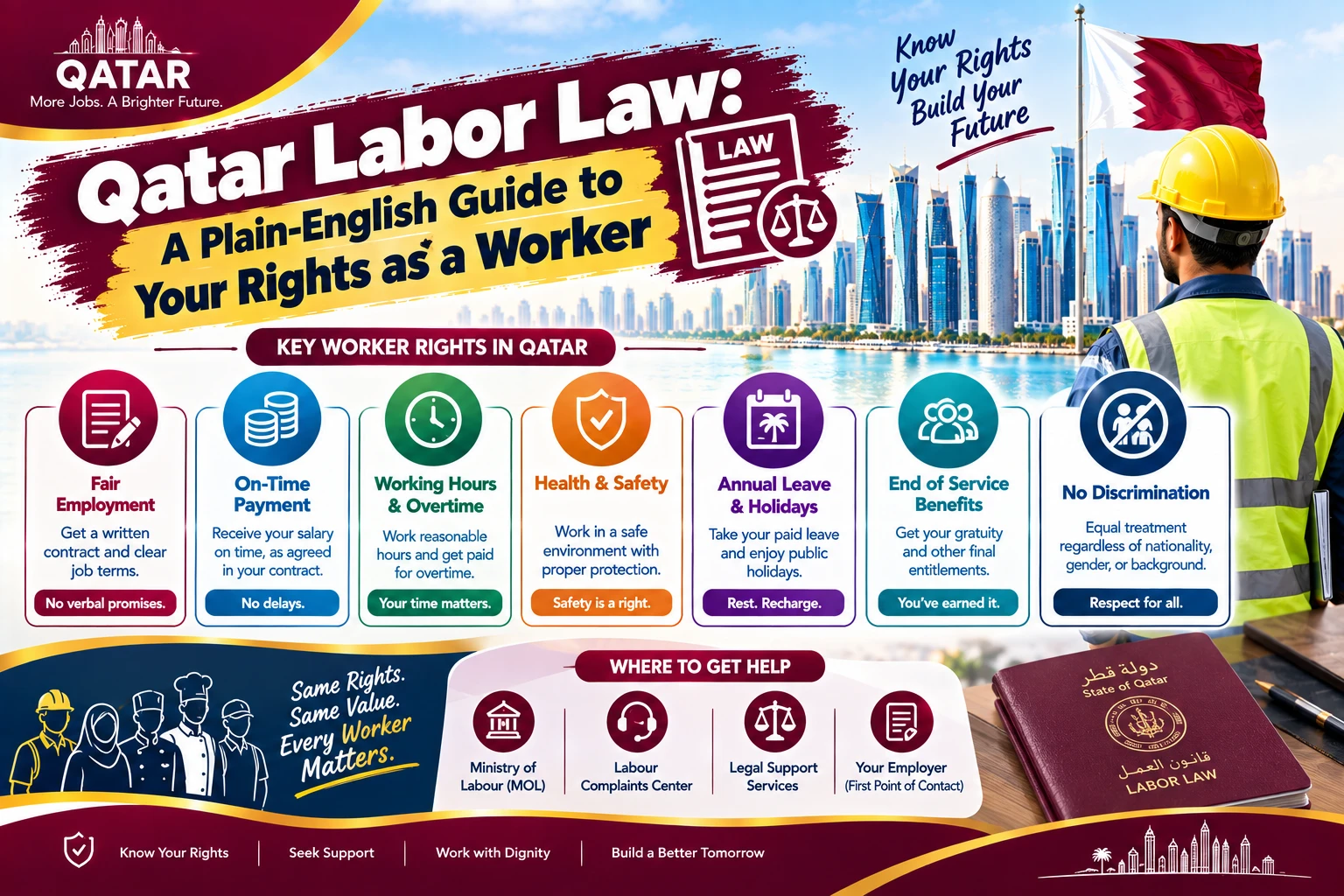
Qatar Labor Law: A Plain-English Guide to Your Rights as a Worker
What Qatar's labor law actually guarantees on hours, leave, overtime, and probation, explained without the legal jargon, plus where to go if your employer isn't following it.