
Workplace Safety in Qatar: What Employers Must Provide
What the Labour Law requires on safety: telling workers about risks, protective measures at no cost, clean and ventilated workplaces with drinking water, first aid, and what workers must do in return.
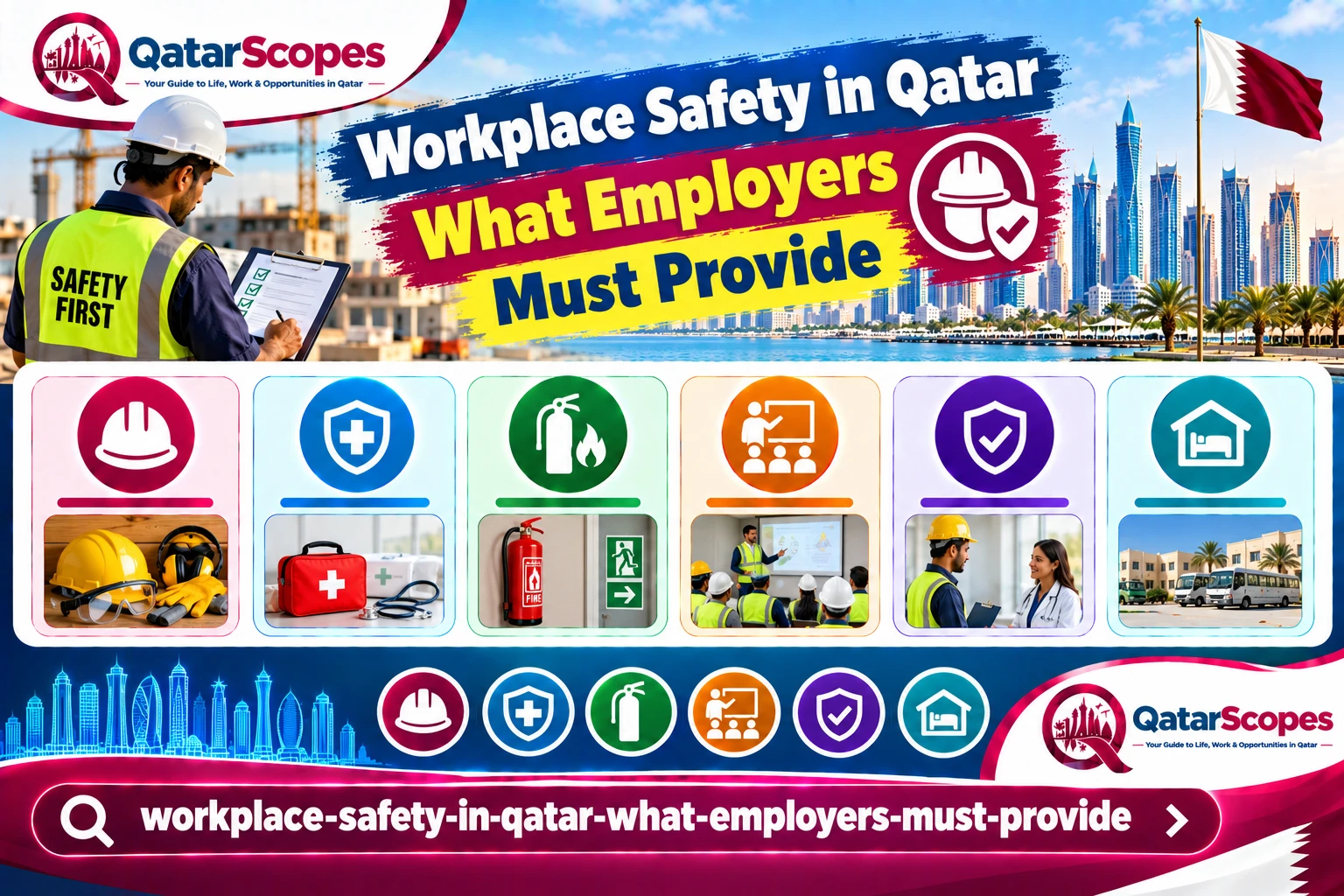
Safety rules sit in a short chapter of Labour Law No. 14 of 2004. This guide follows Articles 99 to 104 as shown on Al Meezan, which we read in September 2026. The law may have been amended and ministerial decisions add detail, so confirm specifics with the Ministry of Labour.
Telling workers about risks (Article 99)
Article 99 says the employer or their representative must inform each worker, when work starts, of the risks of the work and what may develop from them, and of the preventive measures to take. It also says detailed instructions must be affixed in a conspicuous place stating the professional health and safety means of protecting workers from the dangers they may face.
Precautions at no cost to you (Article 100)
Article 100 says the employer must take all precautionary measures to protect workers from any occupational injury or disease arising from the work, or from any accident, fire, defect, or breakdown in machinery and equipment. It says the employer may not charge workers or deduct any amount from their pay for providing these precautions.
If the employer does not take these precautions, or a forthcoming danger threatens workers' health or safety, the article says the Labour Department raises the matter to the Minister to pass a resolution for partial or total closure of the site, or to suspend one or more machines until the danger ends. The employer must pay workers in full during the closure or suspension.
Hygiene, ventilation, and water (Article 103)
Article 103 says the employer must take measures that guarantee hygiene and good ventilation in the workplaces, and provide suitable lighting, potable water for drinking and cleanliness, and drainage systems, in line with regulations and decisions issued by the competent authorities.
First aid, nurses, and clinics (Article 104)
| Number of workers | What Article 104 requires |
|---|---|
| 5 to 25 | A first aid box with medicines and equipment, placed in a conspicuous place near workers, used by a worker trained in first aid |
| More than 25 | A box for each group of 5 to 25 workers |
| More than 100 | A full-time medical nurse, in addition to the first aid boxes |
| More than 500 | A clinic with at least one physician and a medical nurse |
What workers must do (Article 101)
Article 101 says workers must not act or fail to act with the intention of obstructing the employer's health and safety instructions, or damaging safety equipment. It says workers must use the protective equipment and uniform the employer provides, and follow the employer's instructions aimed at protecting them from injuries and diseases. Breaking safety rules can have serious effects. Article 111 says injury rights do not apply if a worker intentionally violated safety instructions or committed gross negligence. See our guide to injured at work in Qatar.
Ministerial decisions (Article 102)
Article 102 says the Minister issues decisions regulating safety appliances, services, and precautionary measures. We did not read those decisions. One example of the kind of rule the Ministry of Labour has used is the summer midday ban. See our guide to Qatar's summer midday work ban.
If your workplace is unsafe
This is our own practical advice.
- Raise the problem with your supervisor or HR in writing, with dates and photos.
- Do not pay for safety equipment the employer must provide, since Article 100 says the employer may not charge for precautions.
- Use the Ministry of Labour hotline listed by Hukoomi, 16505 or 44068979, or file a complaint. See our guide to filing a labor complaint.
- Report any injury, and ask that it be recorded, since the employer must report injuries to the police and the Labour Department.
- Read your wider rights in our Qatar labor law guide.
Common mistakes
- Paying for protective gear that the employer must provide.
- Ignoring safety instructions, which can affect your injury rights under Article 111.
- Not keeping records of unsafe conditions and reports.
- Assuming a small employer has no first aid duty, when Article 104 starts at five workers.
What we could not verify
- Whether amendments or ministerial decisions changed these articles.
- Penalties for employers who break the rules.
- How inspections are requested by an individual worker.
- Rules specific to construction, domestic work, or other sectors.
Frequently asked questions
Who pays for safety equipment in Qatar?
Article 100 says the employer must take precautionary measures and may not charge workers or deduct pay for providing them.
Must employers tell workers about job risks in Qatar?
Yes. Article 99 says the employer must inform each worker at the start of work of the risks and the preventive measures, and affix detailed safety instructions in a conspicuous place.
Is an employer required to provide drinking water and ventilation?
Article 103 requires hygiene, good ventilation, suitable lighting, potable drinking water, and drainage, in line with regulations.
When must a company have a nurse or clinic?
Article 104 requires a first aid box from 5 workers, a full-time nurse above 100 workers, and a clinic with a physician and nurse above 500 workers.
What happens if a workplace is dangerous?
Article 100 says the Labour Department can raise it to the Minister for partial or total closure, with the employer paying workers in full during the closure.
Sources & references

Agha Ali Abbas
Founder & Editor
More on Jobs
Explore everything you need to know about qatar jobs.
Related articles
How to Find a Job in Qatar: A Realistic Guide
Where roles actually get filled, what slows down the visa process, and how to avoid the mistakes that stall an offer.

In-Demand Jobs in Qatar: Sectors That Generally Hire Expats
The sectors that generally employ the most expats in Qatar, from healthcare and finance to tech and construction, with a note on how the 2026 gas disruption may affect energy hiring.
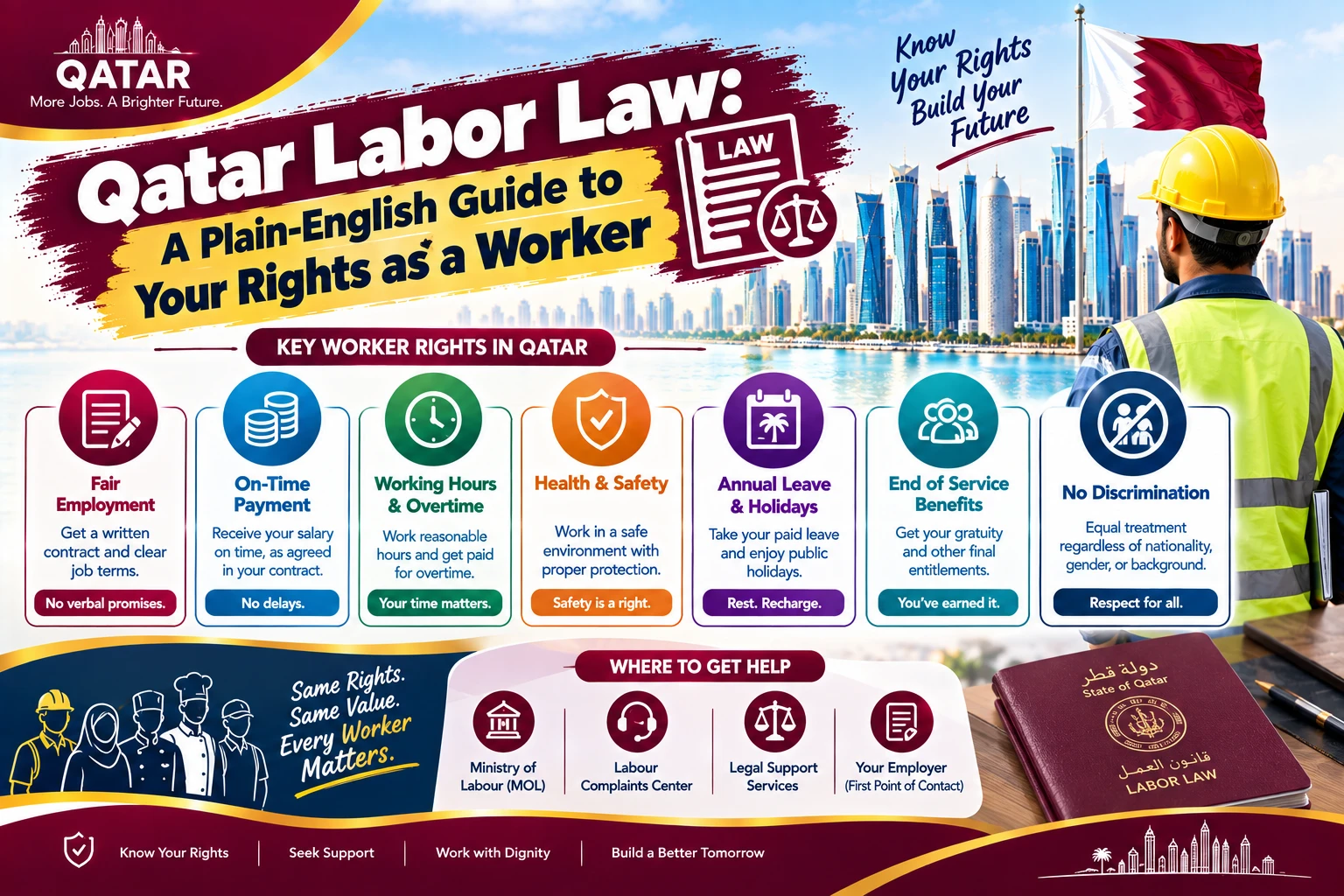
Qatar Labor Law: A Plain-English Guide to Your Rights as a Worker
What Qatar's labor law actually guarantees on hours, leave, overtime, and probation, explained without the legal jargon, plus where to go if your employer isn't following it.