
Maternity Leave in Qatar: Your Rights at Work
What the Labour Law says on maternity leave, pay, nursing breaks, and protection from dismissal for women working in Qatar's private sector, with the limits we could not confirm.
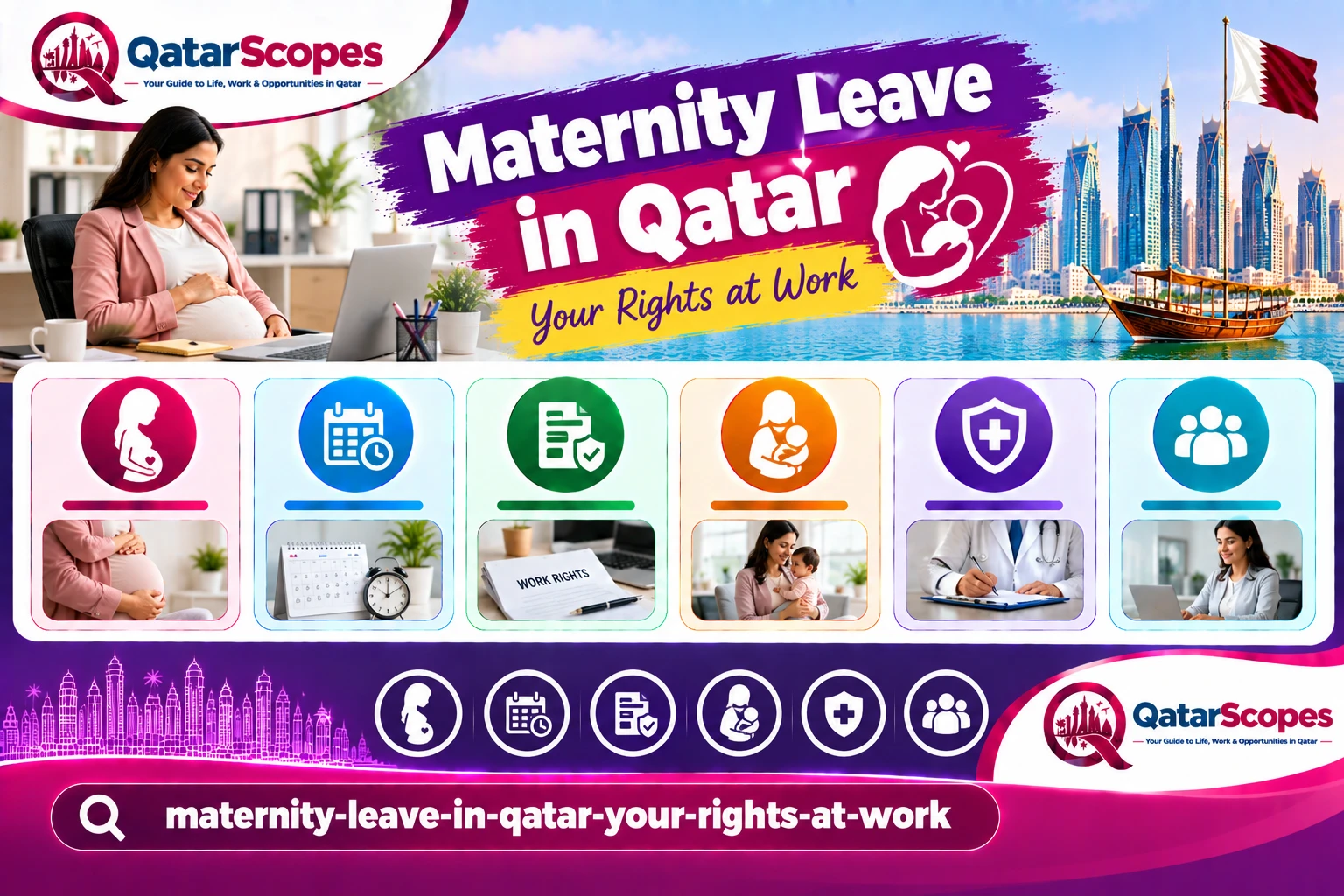
Maternity rights are one of the most searched worker questions, and the exact rules depend on the Labour Law's text. This guide follows Articles 94 to 98 of Labour Law No. 14 of 2004 as shown on Al Meezan, Qatar's official legal portal, which we read in September 2026. It applies to workers under that law. Public sector staff may follow separate civil service rules that we did not check.
Who is eligible (Article 96)
Article 96 says a female worker who has spent a whole year in service with the employer is entitled to maternity leave with full remuneration. We found nothing in the article giving paid leave to a worker with less than a year of service, so ask HR and the Ministry of Labour what applies if you have not completed a year.
How long, and how it is split
| Item | What Article 96 says |
|---|---|
| Paid leave | Fifty days with full remuneration |
| Covers | Prenatal (before birth) and postnatal (after birth) periods |
| Minimum after delivery | Not less than thirty-five days |
The leave is granted on a medical report from a licensed physician stating the expected date of delivery, so get that report early and give it to your employer.
If the leave left after delivery is short
Article 96 says that if the remaining period of leave after delivery is less than thirty days, the worker may be granted a complementary leave from her annual leave. Otherwise, it says the complementary period is treated as leave without pay. If your health after delivery does not allow you to return when the leave ends, you are treated as on leave without remuneration for up to sixty consecutive or interrupted days, with a medical certificate from a licensed physician. Receiving the delivery leave does not affect your right to any other leave.
Nursing breaks (Article 97)
Article 97 says a nursing female worker is entitled, in addition to the rest period in Article 73, to one hour daily for nursing for a period of one year, starting after the end of the maternity leave. The worker decides when to take it. The nursing hour counts as working time and does not reduce pay.
Protection from dismissal (Article 98)
Article 98 says the employer may not terminate a female worker's contract because of her marriage or because she takes the Article 96 leave. It also says the employer may not notify the worker of termination during that leave, or send a notice that ends during it. For how notice and dismissal work in general, see our guide to termination and notice rules.
Other rules on women's work (Articles 94 and 95)
Article 94 says a female worker may not be employed in dangerous, hard, or arduous work, or work that harms her health or morals, or other work specified by a ministerial decision. Article 95 says she may work only at times set by a ministerial resolution. We did not read those decisions, so ask the Ministry of Labour what applies to your job.
What to do
This is our own practical advice, not part of the law.
- Check that you have completed a year of service before you rely on the paid leave.
- Get the medical report with the expected delivery date and give it to HR early, in writing.
- Ask HR in writing how the 50 days will be counted, and how your annual leave would be used if it is needed.
- Keep copies of your contract, payslips, and the leave approval. You can check your registered contract with our guide to checking your employment contract online.
- If your leave is refused or you are dismissed, see our guide to filing a labor complaint.
- After the birth, see our guide to registering a newborn's birth in Qatar.
Common mistakes
- Assuming the leave is paid even before completing a year of service.
- Forgetting to give the medical report with the expected delivery date.
- Not asking how the 50 days are counted and how annual leave interacts.
- Assuming public sector rules are the same as the Labour Law.
What we could not verify
- Whether the 2020 amendments or later changes altered these articles.
- Pay for women with less than a year of service.
- Maternity rules for public sector employees and domestic workers.
- The ministerial decisions behind Articles 94 and 95.
Frequently asked questions
How many days of maternity leave do you get in Qatar?
Article 96 of the Labour Law gives a woman who has completed a whole year of service 50 days on full remuneration, including before and after delivery, with at least 35 days after delivery.
Is maternity leave paid in Qatar?
Yes under Article 96 for eligible workers, with full remuneration for the 50 days. Any extra leave for health reasons can be without pay.
Can I be fired for being pregnant or on maternity leave in Qatar?
Article 98 says the employer may not terminate a contract because of marriage or because the worker takes the maternity leave, and may not notify termination during the leave.
Do I get breaks for breastfeeding in Qatar?
Article 97 gives one hour daily for nursing for one year, starting after the maternity leave, counted as working time without reduced pay.
What do I need to get maternity leave?
A medical report from a licensed physician stating the expected delivery date, and a whole year of service with the employer.
Sources & references

Agha Ali Abbas
Founder & Editor
More on Jobs
Explore everything you need to know about qatar jobs.
Related articles
How to Find a Job in Qatar: A Realistic Guide
Where roles actually get filled, what slows down the visa process, and how to avoid the mistakes that stall an offer.

In-Demand Jobs in Qatar: Sectors That Generally Hire Expats
The sectors that generally employ the most expats in Qatar, from healthcare and finance to tech and construction, with a note on how the 2026 gas disruption may affect energy hiring.
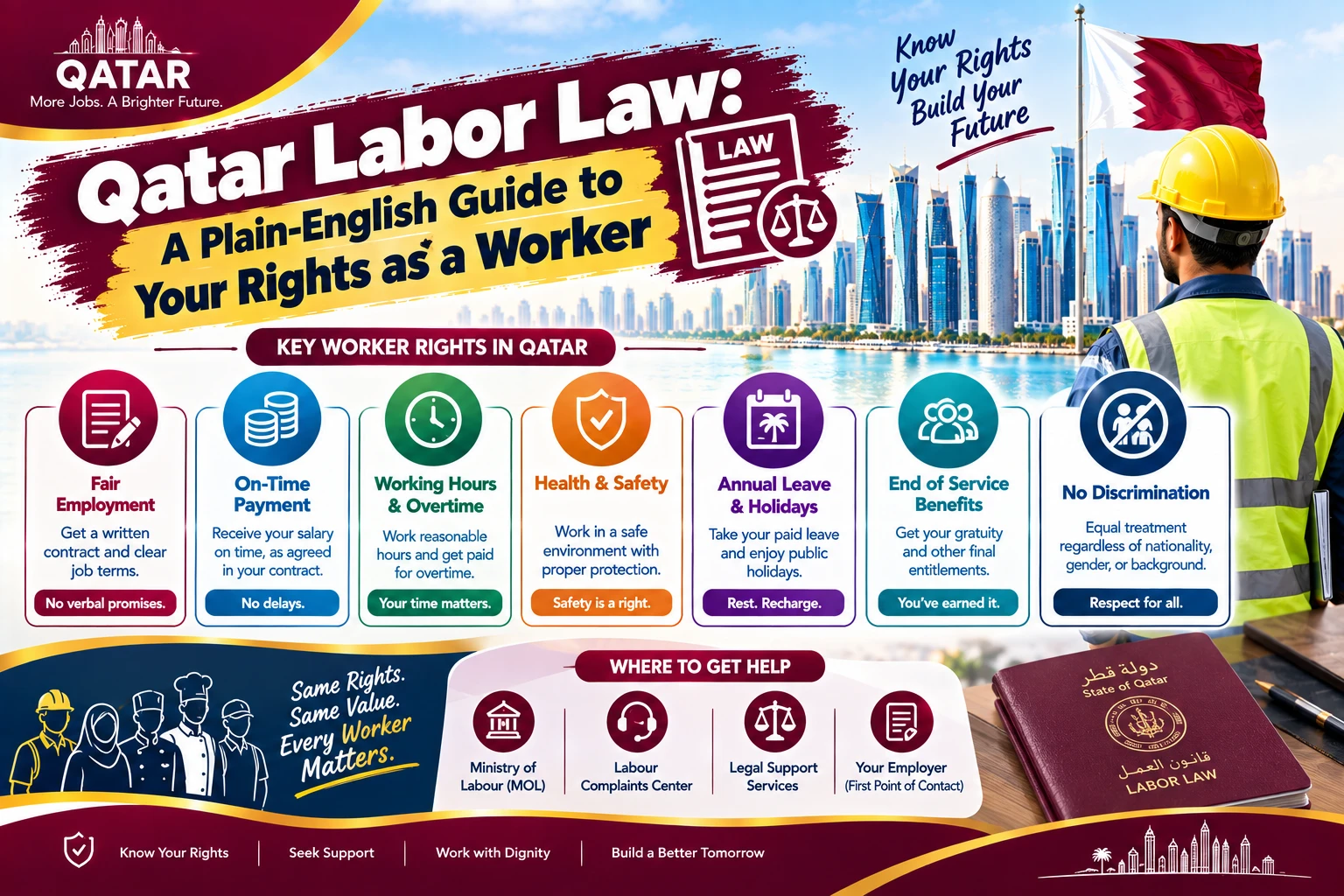
Qatar Labor Law: A Plain-English Guide to Your Rights as a Worker
What Qatar's labor law actually guarantees on hours, leave, overtime, and probation, explained without the legal jargon, plus where to go if your employer isn't following it.