
Weekly Rest Day and Public Holidays in Qatar: What Private Sector Workers Get
Articles 75 and 78 of the Labour Law give a paid weekly rest of at least 24 hours and paid holidays for Eid and Independence Day. What you are owed if you work on those days.

Most questions about rest days and holidays in Qatar come down to two things: how many paid days off you get, and what you are owed when your employer asks you to work. This guide follows Articles 73 to 78 of the Labour Law as shown in English on Al Meezan, Qatar's official legal portal. It covers workers under the Labour Law, not public sector staff.
Your weekly rest day
Article 75 says every worker must get a paid weekly rest of not less than 24 consecutive hours. Friday is the usual weekly rest day for all workers except shift workers. The article also says that, with the exception of shift workers, a worker may not be employed on two Fridays in a row.
If you work on your rest day
If the circumstances of the work make it necessary to work on the weekly rest day, Article 75 says the worker must be compensated with another day off, and must be paid what is payable for the rest day or the basic wage plus an increase of at least 150 percent of it. The English text of this sentence is not easy to read, so check the figure with the Ministry or your contract before you rely on it.
| Situation | What Article 75 says |
|---|---|
| Weekly rest | At least 24 consecutive hours, paid |
| Usual day | Friday, except for shift workers |
| Work on the rest day | Another day off, plus payment for the work (basic wage plus at least 150 percent, as worded) |
| Two Fridays in a row | Not allowed, except for shift workers |
Working hours around the rest day
Article 73 sets the ordinary working hours at 48 hours a week, eight a day, and 36 hours a week, six a day, in Ramadan. Article 74 allows extra hours up to ten actual hours a day, paid at the basic wage plus at least 25 percent, and at least 50 percent for work between 9 pm and 6 am, except for shift workers. Our overtime guide goes through these numbers, and the summer midday work ban explains the extra outdoor limits.
Who is not covered
Article 76 says Articles 73, 74 and 75 do not apply to people in senior positions that give them the employer's authority over workers. Article 73 also does not apply to workers doing preparatory or complementary work before or after hours, or to guards and cleaners, and other groups the Minister may decide. If you are in one of these groups, your rest and hours may follow an order of the Minister, which we did not read.
Public holidays with pay
Article 78 says a worker is entitled each year to leave with full pay for: three working days for Eid Al-Fitr, three working days for Eid Al-Adha, one working day for Independence Day, and three working days specified by the employer.
That is ten paid days a year in the text we read. If the work makes it necessary to employ the worker on any of these days, Article 78 says Article 75 applies, so the rest day rules above apply to holiday work too. In plain terms, you should get another day off and the extra pay.
What your employer must display
Article 77 says the employer must put up, at the main gates the workers use and in a visible place in the workplace, a table showing the closing or weekly rest day, the working hours and the rest breaks for each group of workers, and must give the Department a copy. If you have never seen one, you can ask HR for it.
If your employer does not follow the rules
- Ask HR in writing for the rest day or holiday you were owed, and keep the reply.
- Keep a record of the days you worked and any pay slips.
- If it is not fixed, use our guide to filing a labor complaint.
- For related leave rights, see annual leave and sick leave.
What we could not verify
- Which date counts as Independence Day today. The article uses that name, and Qatar also marks National Day, so ask HR which dates your employer follows.
- Whether later amendments or Council of Ministers decisions changed Articles 73 to 78, and the dates the government sets for Eid holidays in a given year.
- The exact reading of the pay sentence in Article 75, which is not clear in English.
- How shift workers are treated, because the rest day rule for them depends on their schedule and was not in the text we read.
- How the rules apply to public sector staff, domestic workers and free zone employees.
Frequently asked questions
Is Friday the weekly rest day for all workers in Qatar?
Article 75 says Friday is the usual weekly rest day for all workers except shift workers. The rest must be at least 24 consecutive hours and paid.
How many paid public holidays do workers get?
Article 78 lists three working days for Eid Al-Fitr, three for Eid Al-Adha, one for Independence Day and three days the employer specifies, all with full pay.
What am I owed if I work on a public holiday?
Article 78 says Article 75 applies, so you should get another day off and be paid what is payable for work on a rest day. The English wording of the exact rate is unclear, so check it with the Ministry.
Can my employer make me work two Fridays in a row?
Article 75 says it is not allowed, except for shift workers.
Sources & references
- Al Meezan, Law No. 14 of 2004, Articles 73 and 74, hours and overtime (checked Oct 2026)
- Al Meezan, Law No. 14 of 2004, Article 75, weekly rest (checked Oct 2026)
- Al Meezan, Law No. 14 of 2004, Articles 76 and 77, exceptions and posted schedule (checked Oct 2026)
- Al Meezan, Law No. 14 of 2004, Article 78, public holidays (checked Oct 2026)

Agha Ali Abbas
Founder & Editor
More on Jobs
Explore everything you need to know about qatar jobs.
Related articles
How to Find a Job in Qatar: A Realistic Guide
Where roles actually get filled, what slows down the visa process, and how to avoid the mistakes that stall an offer.

In-Demand Jobs in Qatar: Sectors That Generally Hire Expats
The sectors that generally employ the most expats in Qatar, from healthcare and finance to tech and construction, with a note on how the 2026 gas disruption may affect energy hiring.
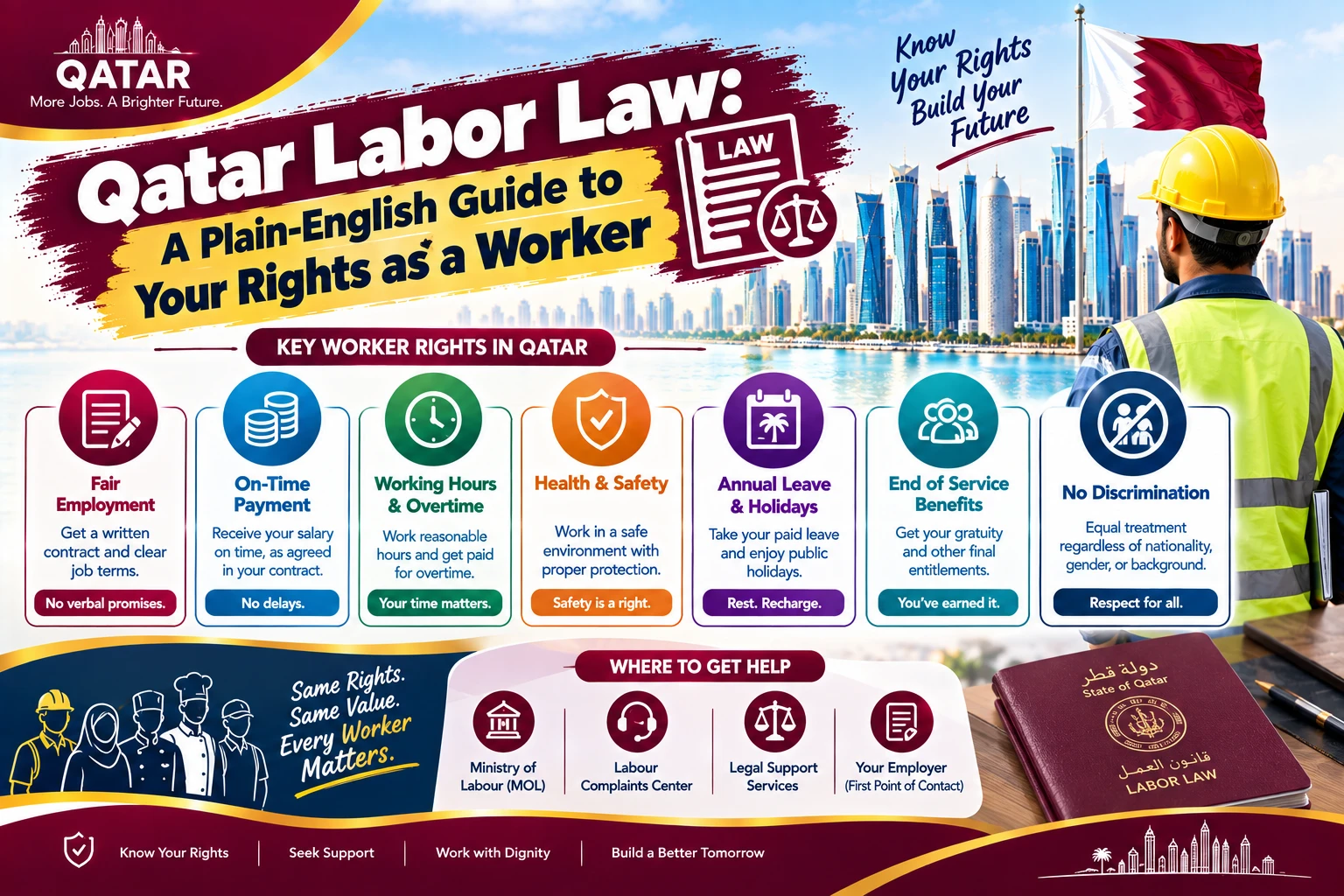
Qatar Labor Law: A Plain-English Guide to Your Rights as a Worker
What Qatar's labor law actually guarantees on hours, leave, overtime, and probation, explained without the legal jargon, plus where to go if your employer isn't following it.