
Probation Period in Qatar: Six Month Limit and Notice Rules
What Qatar's Labour Law says about probation: the six month maximum, one probation per employer, termination during probation, and what a contract must contain.

Probation is one of the most common contract questions, and it is also where people hear wrong advice. This guide follows Articles 38 to 40 of Labour Law No. 14 of 2004 as shown on Al Meezan, Qatar's official legal portal, which we read in October 2026. It applies to workers under that law. Public sector staff and domestic workers may follow other rules that we did not check.
What Article 39 says
Employment contracts may include a condition that puts the worker on probation, agreed by both parties. The probation period cannot exceed six months from the date work starts. The article also says employers may not put workers on probation more than once with the same employer.
Ending a contract during probation
Article 39 says the employer may terminate the contract before the end of probation if the worker fails to carry out their duties as the contract requires. The employer must notify you of that decision within at least three days from the termination date. Our reading is that this puts the notice duty on the employer. We could not confirm any rule in these articles on how a worker leaves during probation, or whether a new employer needs your current employer's consent, so check your contract and ask the Ministry of Labour before you rely on any claim about that. Our guide to changing jobs explains the transfer process in more detail.
Get probation in writing (Article 38)
Article 38 says employment contracts must be in writing, authenticated by the Department, in three copies: one for each party and one deposited with the Department. The contract must state in particular the employer and place of work, your details and profession, the date of the contract and of starting work, the nature of the work, the period if fixed, and the agreed pay with the date and method of payment. If there is no written contract, you may prove the work relationship by all admissible means of evidence. Check that probation is written in your contract, and you can verify your registered contract using our guide to checking your employment contract online.
Fixed term contracts (Article 40)
Article 40 says a fixed term contract cannot be longer than five years, though it can be renewed by agreement. If the contract is not renewed and both sides keep working under it without a clear agreement after it expires, it is considered renewed for an unlimited time on the same conditions, and your service is counted from the start of work with that employer.
What this means for your entitlements
These articles do not say how probation time counts towards leave or gratuity, so ask HR in writing. For leave, see our guides to sick leave and annual leave. For gratuity, see end of service gratuity.
What to do
This is our own practical advice, not part of the law.
- Read the probation clause before you sign and check it is not longer than six months.
- Keep your copy of the signed contract, and confirm the registered version matches it.
- If you are told your contract is ending, ask for the notice in writing and note the date.
- If you have been on probation with the same employer before, point out Article 39 in writing.
- If you believe a dismissal was unfair, see our guide to termination rules and filing a labor complaint.
- For hours, leave and other rules, see our Qatar labor law guide.
Common mistakes
- Accepting a probation clause longer than six months.
- Agreeing to a second probation with the same employer.
- Not keeping a copy of the signed contract.
- Relying on advice about quitting during probation without checking the contract.
What we could not verify
- Rules on how a worker leaves during probation, and whether a new employer needs the current employer's consent. These are not in Articles 38 to 40.
- Whether later amendments, including the 2020 changes on job mobility, altered these articles. Al Meezan showed the 2005 text with no amendment notice when we read it.
- Probation rules for public sector employees and domestic workers.
Frequently asked questions
How long can a probation period be in Qatar?
Article 39 says probation cannot exceed six months from the date work starts, and the employer cannot put a worker on probation with the same employer more than once.
Can an employer terminate a contract during probation in Qatar?
Article 39 allows termination before probation ends if the worker fails to carry out their duties under the contract, with notice of the decision given at least three days from the termination date.
Must probation be in the contract?
Article 39 says contracts may provide for probation agreed by both parties, and Article 38 says the contract must be written and authenticated, so confirm probation is written in yours.
What is the longest fixed term contract in Qatar?
Article 40 says a fixed term contract cannot exceed five years, renewable by agreement. If work continues without a clear agreement after it expires, it is treated as renewed for an unlimited time.
Can I leave a job during probation in Qatar?
The articles we read do not set a rule for how a worker leaves during probation. Check your contract and ask the Ministry of Labour before you resign.
Sources & references

Agha Ali Abbas
Founder & Editor
More on Jobs
Explore everything you need to know about qatar jobs.
Related articles

How to Find a Job in Qatar: A Realistic Guide
Where roles actually get filled, what slows down the visa process, and how to avoid the mistakes that stall an offer.

In-Demand Jobs in Qatar: Sectors That Generally Hire Expats
The sectors that generally employ the most expats in Qatar, from healthcare and finance to tech and construction, with a note on how the 2026 gas disruption may affect energy hiring.
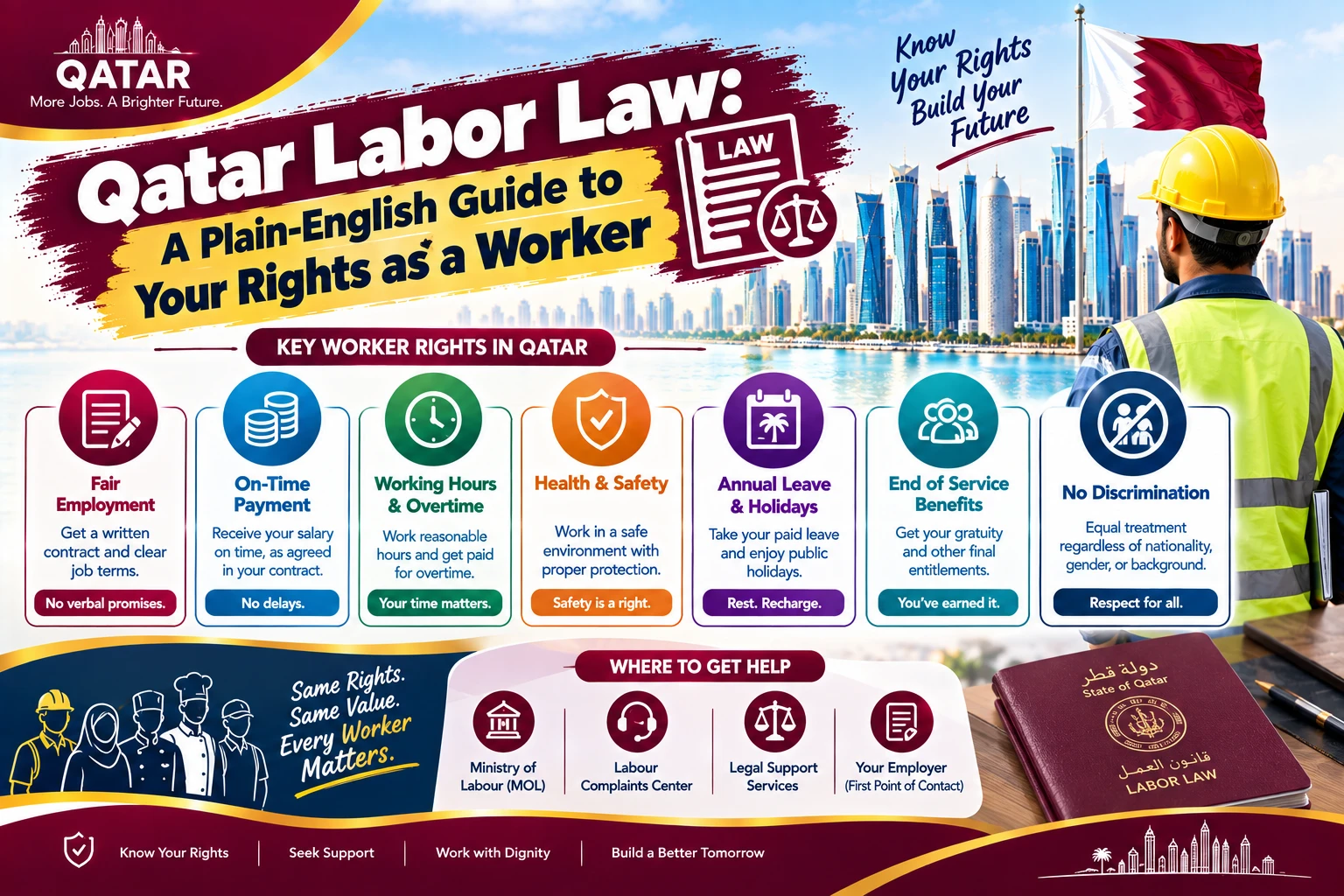
Qatar Labor Law: A Plain-English Guide to Your Rights as a Worker
What Qatar's labor law actually guarantees on hours, leave, overtime, and probation, explained without the legal jargon, plus where to go if your employer isn't following it.