
Qatar Labour Law 2026 Amendments: What Changed for Workers
A plain guide to Law No. 9 of 2026, which amended Qatar's Labour Law in June 2026: non-compete clauses, strikes, disputes, part-time and freelance work, certification and enforcement, and what stayed the same.

If you read a Qatar labour guide written before July 2026, including some of ours, it describes the 2005 text of the law. In June 2026 the Amir issued Law No. 9 of 2026, and the changes matter for workers, especially on non-compete clauses, disputes and strikes. This page summarizes what four law firm alerts and the Qatar News Agency report. We could not read the law itself, because Al Meezan did not load for us, so article numbers appear only where a source gave one. It is general information, not legal advice.
The short version
| Topic | What is reported |
|---|---|
| Non-compete clauses | Maximum after employment raised from one year to two. Enforced only after Ministry of Labour approval. Void if employment ends during probation |
| Labour disputes | Settlement through the Ministry first, then the Labour Dispute Resolution Committee, with electronic hearings allowed |
| Strikes | Right kept, with notice, a six working day limit and other conditions |
| Part-time and freelance workers | Excluded from the Labour Law, unless the Council of Ministers extends it or issues separate rules |
| Certain professions | Training and examination certificate needed before starting work |
| Joint committees | Compulsory for establishments with 100 or more workers (previously optional from 30) |
| Enforcement | Wider ministry powers to suspend an employer's transactions and name repeat violators |
Non-compete clauses
Clyde & Co reports that the maximum post-termination non-compete rises from one year to two (Article 43). Crowell & Moring and K&L Gates add that a non-compete is enforced only after Ministry of Labour approval, that the approval process is still to be clarified, and that a clause is void if the employment ends during probation. This reverses part of the 2020 amendments, according to Crowell. Our guide to non-compete clauses has been updated with these points.
Labour disputes
Clyde & Co reports that a dispute must go to the Ministry for amicable settlement first, and only then to the Labour Dispute Resolution Committee (Article 115). K&L Gates reports a seven day window to try to settle, referral to the Committee within three working days if that fails, early settlements that can be enforced at once, limitation periods paused while a settlement request is pending, and electronic proceedings. See our guide to how labour disputes work after the 2026 amendments.
Strikes
The right to strike remains, with conditions. See the 2026 strike rules.
Part-time and freelance workers
Crowell, K&L Gates and Clyde & Co report these workers are excluded from the Labour Law. QNA describes the law as setting a legal framework for part-time and freelance work with implementing decisions to follow. Qatar Living's guide contradicts itself on this. See part-time and freelance work in Qatar.
Vocational certification
A new Article 23 bis lets the Ministry designate professions that may be practised only after accredited training, examinations and a licence, so workers in those jobs need a certificate before starting. The list of professions will come in later ministerial decisions. QNA quotes the Qatar Society of Engineers welcoming it for skilled trades.
Joint committees
QNA names Article 124: establishments with 100 or more workers must form joint committees of management and employee representatives. Crowell says this was optional from 30 workers before, and that non-compliance carries fines of QAR 2,000 to QAR 5,000.
Enforcement and wages
Clyde & Co reports a new Article 146 bis: the Minister can suspend all or part of an employer's applications and transactions with the Ministry after a breach, and for repeated violations or collective disputes over delayed wages, sanctions can reach related establishments used to avoid the law. Crowell adds that repeat violators can be named on the Ministry's website, and that workers affected by wage violations may transfer or terminate with repatriation costs paid by the employer. For recruitment agencies, Crowell reports administrative fines of QAR 3,000 to QAR 25,000 for 23 violations. In September 2026 a separate decision changed salary deadlines. See salary due dates in Qatar.
What was not reported as changed
Clyde & Co takes the view that the amendments do not fundamentally alter employers' and employees' substantive rights and instead modernize procedures and strengthen the Ministry. A Qatar Living guide lists the minimum wage, working hours, overtime and end of service gratuity as unchanged. That is a secondary source, so check anything that affects your pay. Our guides to overtime, annual leave, notice periods and end of service gratuity were written from the earlier text, and no source we read reports changes to those articles.
What to do as a worker
- Keep a copy of your contract and read any non-compete clause before you sign. See checking your contract online.
- Keep records of salary payments and raise late pay early.
- If you have a dispute, use the Ministry's settlement step first. See how to file a labor complaint in Qatar.
- If you are a part-time or freelance worker, check which rules cover you.
- Watch for ministerial decisions on certification, non-compete approvals and part-time work.
What we could not verify
- The text of the law, the effective date and article numbers beyond those quoted. Law firm bulletins give their publication dates, not a commencement date, and QNA says only that the law entered into force in accordance with its provisions.
- Fine amounts for wage violations. Qatar Living gives QAR 2,000 to QAR 10,000 and imprisonment in serious cases, which law firms did not confirm.
- Whether employment contracts must be registered on the Ministry's e-contract system to be valid, as Qatar Living says. The law firms do not mention it.
- Implementing decisions, which law firms said were still awaited in July 2026.
Frequently asked questions
What changed in Qatar's Labour Law in 2026?
Law No. 9 of 2026 changed non-compete clauses, labour dispute procedure, strikes, joint committees, certification for certain professions, recruitment penalties and the Ministry's enforcement powers, and excluded part-time and freelance workers from the law.
Did the 2026 amendments change the minimum wage or gratuity?
Law firms say the amendments do not fundamentally change core rights, and Qatar Living lists the minimum wage, hours, overtime and gratuity as unchanged. We found no source reporting a change to them.
When did the 2026 Labour Law amendments take effect?
The law was published on 25 June 2026 and QNA says it entered into force in accordance with its provisions. The sources we read give no separate commencement date.
Sources & references
- Clyde & Co, "Qatar updates the Labour Law: what employers need to know" (1 July 2026)
- K&L Gates, "Qatar introduces significant amendments to the Labour Law" (1 September 2026)
- Crowell & Moring, "Qatar labor law: key amendments introduced by Law No. 9 of 2026" (30 June 2026)
- QNA, "Labour law amendments establish legislative framework" (5 July 2026)
- Qatar Living, "Labour law changes in Qatar 2026: expat guide" (27 July 2026)

Agha Ali Abbas
Founder & Editor
More on Jobs
Explore everything you need to know about qatar jobs.
Related articles

How to Find a Job in Qatar: A Realistic Guide
Where roles actually get filled, what slows down the visa process, and how to avoid the mistakes that stall an offer.

In-Demand Jobs in Qatar: Sectors That Generally Hire Expats
The sectors that generally employ the most expats in Qatar, from healthcare and finance to tech and construction, with a note on how the 2026 gas disruption may affect energy hiring.
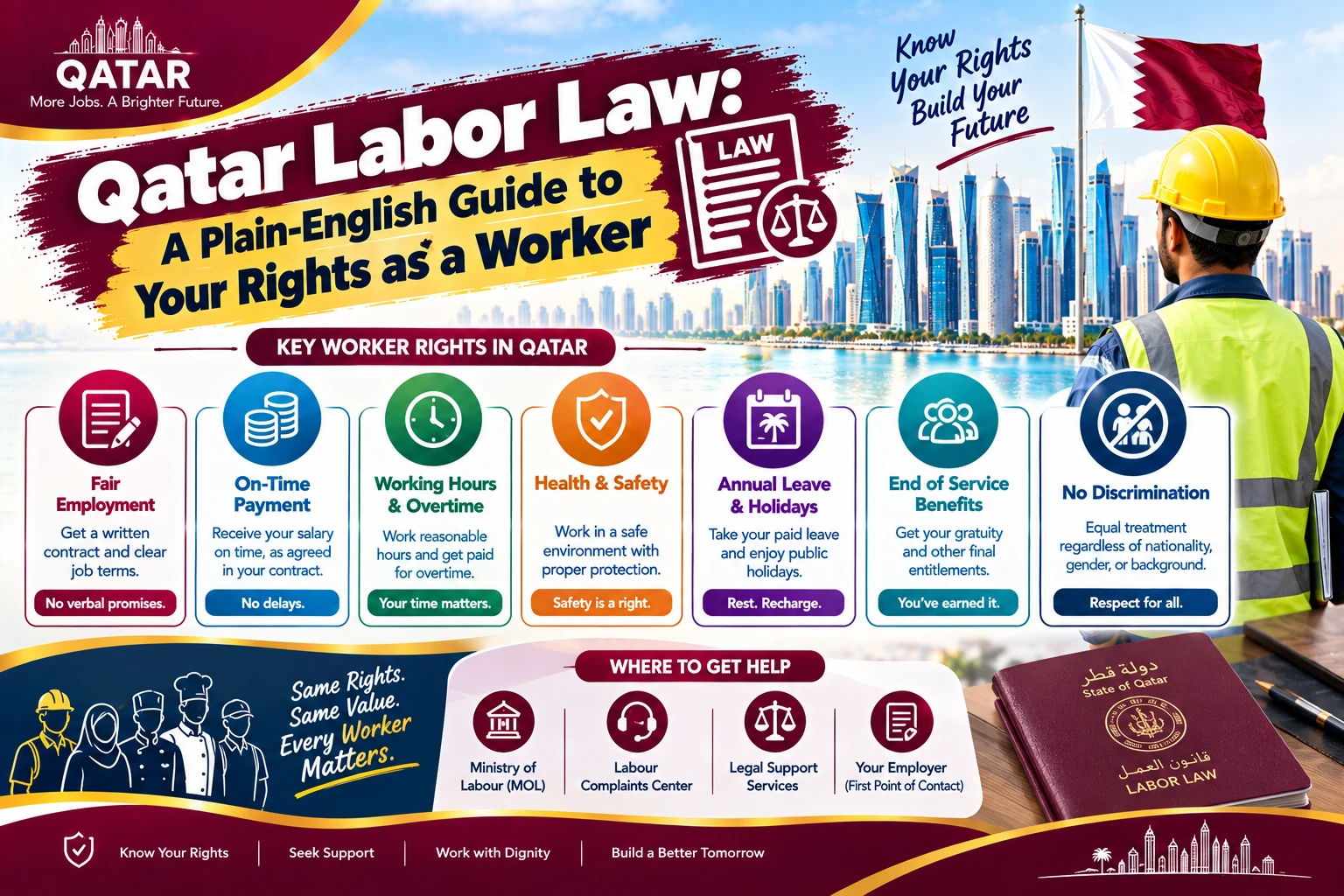
Qatar Labor Law: A Plain-English Guide to Your Rights as a Worker
What Qatar's labor law actually guarantees on hours, leave, overtime, and probation, explained without the legal jargon, plus where to go if your employer isn't following it.