
Qatar Traffic Fine Showing by Mistake? How to Check and Dispute It
Got a fine you do not recognize? Here is how to verify it, the 14 day objection window, the evidence that works, and what to do if your objection is rejected.
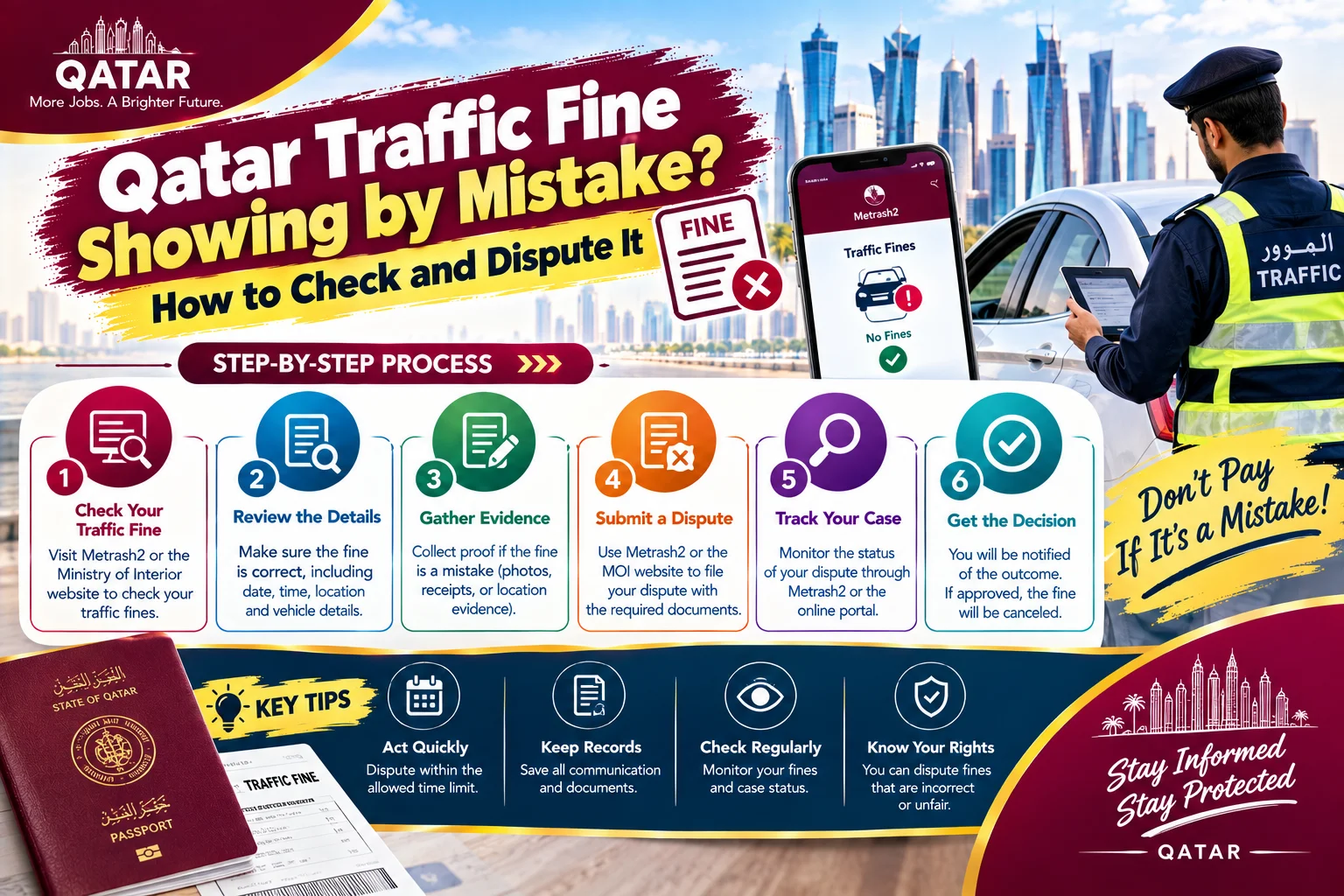
If a traffic fine in Qatar looks wrong, act quickly. You can object to it through the Metrash app under Traffic Services, but the window is short, reported as 14 days from the date the violation was recorded, and you generally get one objection per violation. Check the details first, gather evidence that the fine is not yours or is incorrect, file the objection before you pay, and keep every reference. Most successful disputes come down to clear proof that the plate, the vehicle, or the driver was wrong.
This guide is about disputing a fine you believe is wrong. If you just need to see what you owe and pay it, our guide to checking and paying traffic fines covers that. Here we focus on why fines end up on the wrong person, how to prove it, and what to do at each stage.
Quick answer: what to do right now
- Open Metrash and look at the fine's date, time, place, violation type, and plate number.
- Compare them against where you were and which vehicle you were driving.
- Note the date the violation was recorded and count 14 days from it.
- Collect evidence before you object: photos, documents, and proof of your location or the vehicle's status.
- File the objection in Metrash before you pay, because a paid fine may no longer be disputable.
Confirm the fine is really wrong
It is easy to assume a fine is a mistake when it is really a forgotten trip or a family member's driving. Before you object, check four things. Does the plate number match your vehicle exactly, including the letters and numerals? Was the vehicle in your possession on that date? Could a family member, colleague, or friend have been driving? And does the location make sense for the vehicle? An objection that says the fine is wrong when the facts show otherwise wastes your one attempt.
Why fines end up on the wrong person
These are the real situations behind most disputed fines.
- You sold the car and the ownership was not transferred. The fine goes to the registered owner, which is you until the transfer is complete.
- You rented or borrowed the car. Fines are usually recorded against the registered vehicle, so you may need the rental agreement or the borrower's details to redirect responsibility.
- The plate was misread by the camera or entered incorrectly, so a similar plate is charged.
- The same violation was recorded twice.
- A new plate was issued to you that was previously used by someone else, or the reverse.
- The vehicle registration had lapsed because of a renewal delay that was not your fault.
- The signage, speed limit, or road markings at the location were unclear or changed.
Knowing which of these applies shapes the evidence you need.
The 14 day deadline
The objection window is commonly reported as 14 days from the date the violation was registered. After that the fine is treated as final. Check the exact deadline shown in your Metrash account for your specific violation, because the date that matters is when it was registered, not when you noticed it. If you are close to the deadline, file first and collect extra documents afterward if the system lets you add them.
How to file an objection in Metrash, step by step
The exact wording of the screens can change with app updates, but the path is generally the same.
- Log in to the Metrash app using your QID and your credentials.
- Go to Traffic Services and open Traffic Violations.
- Select the violation you want to dispute and review the details.
- Choose the objection option and give a clear reason.
- Attach your supporting documents and submit.
- Save the reference number and a screenshot of the confirmation.
If Metrash itself is misbehaving, see our guide on Metrash problems and fixes. You can also use the Ministry of Interior website, or visit the Traffic Department in person.
Evidence that helps
The strongest objections are short and specific, and backed by documents. Useful evidence includes:
- The vehicle transfer or sale documents with the date.
- A rental or lease agreement showing who had the car.
- A photo of your registration and plate.
- GPS data, a parking receipt, a toll or fuel receipt, or a work record showing you were elsewhere.
- Photos of the road signs or markings at the location, if signage is the issue.
- A workshop or service record showing the car was not on the road.
Write your reason in plain, factual sentences: what happened, which document proves it, and what you are asking for. Avoid emotion and avoid claims you cannot support.
What happens after you object
You should receive an SMS or an update in the app. Guides report response times from a few working days to as long as 30 days, so do not assume a timeline, and check the status in Metrash. Only one objection is normally allowed for each violation, so make it complete the first time. While it is pending, keep an eye on any consequences that depend on the fine, such as vehicle registration renewal.
Common mistakes that sink an objection
Most rejected objections share the same weaknesses. People write a long emotional explanation instead of one clear reason. They attach no documents, or documents that do not match the date of the violation. They object to the wrong thing, for example arguing that a speed limit is unfair rather than showing the fine is not theirs. And they wait until the last day, then discover the system will not accept a large file. Keep the reason to two or three sentences, attach only relevant proof, check that the dates line up, and file with a few days to spare.
If your objection is rejected
You can go in person to the Traffic Department and present your case, with your QID, vehicle registration, and every supporting document, including the evidence you used online. Ask what the specific reason for rejection was, and whether there is a further review route. If you decide the fine is valid after all, pay it.
Should you pay first?
Be careful. Reports say a fine that has already been paid can no longer be disputed, so if you plan to object, do it before you pay. The trade-off is that unpaid fines can block vehicle registration renewal and, in serious cases, affect travel. If you must renew or travel soon and cannot wait for the outcome, weigh the cost of the fine against the hassle, and ask the Traffic Department what your options are before you pay under protest.
Real problems people run into
- The problem is with vehicle registration rather than a fine. See our guide to vehicle registration renewal problems.
- The fine shows a vehicle I sold years ago. Bring the sale and transfer documents to the Traffic Department, and ask them to update the record. Object in Metrash as well if the window is open.
- The camera shows a car I do not recognize. Compare the plate character by character. A misread plate is one of the clearest grounds for objection.
- My spouse was driving. If the fine is valid, it is usually simpler to pay it. An objection based on who was driving is unlikely to succeed on its own.
- I missed the 14 days. Ask the Traffic Department whether any route is left, for example a clear administrative error. Do not expect an automatic reopening.
- I cannot renew my registration because of the fine. Ask the Traffic Department whether the renewal can proceed while an objection is pending.
A sample objection you can adapt
Short, factual objections read best. Adapt this to your situation: 'I object to violation number 12345 recorded on 3 September. The vehicle with this plate was sold on 12 May, and the ownership transfer is attached. I was not the owner or the driver on the date of the violation. I ask that the fine be cancelled or transferred to the current owner.' Attach the transfer papers, and add your contact number. If the reason is a misread plate, say which characters differ and attach a photo of your registration. Keep the tone neutral, and do not accuse anyone.
Checklist by scenario
- Sold or gifted the car: transfer papers with a date, the buyer's details if you have them, and a copy of the updated registration.
- Rented or lent the car: the rental agreement or a signed note showing who had the vehicle, with dates and times.
- Wrong plate: a photo of your plate and registration, and the plate shown on the fine, marked where they differ.
- Duplicate fine: the two violation numbers, with the same date, time, and place, and a note that they are the same event.
- Unclear signage: dated photos of the sign and the road, taken from the driver's view.
How to avoid wrong fines
Complete vehicle transfers properly and keep the paperwork. Check Metrash for your fines every month. Keep rental agreements and parking receipts for a few months. Update your contact details so notifications reach you. If you are still working out your driving papers, our guide on getting a driving license in Qatar explains the basics.
Frequently asked questions
How do I dispute a traffic fine in Qatar?
Log in to the Metrash app, go to Traffic Services and Traffic Violations, select the fine, choose the objection option, give a clear reason, attach evidence, and submit. Save the reference number.
How long do I have to object to a traffic fine in Qatar?
The window is commonly reported as 14 days from the date the violation was registered. Check the deadline shown for your specific violation in Metrash and act early.
Can I object to a traffic fine after paying it?
Reports say a paid fine can no longer be disputed, so file the objection before you pay if you plan to dispute it.
What evidence should I use to dispute a wrong fine?
Use documents that prove the fine is not yours or is incorrect, such as vehicle transfer papers, a rental agreement, photos of the plate, receipts or GPS data showing your location, and photos of unclear signage.
What if my Metrash objection is rejected?
You can visit the Traffic Department in person with your QID, vehicle registration, and all supporting documents, and ask for the specific reason and any further review route.
Why is a fine showing for a car I sold?
Fines are recorded against the registered owner. If the ownership transfer was never completed, the fine stays with you until the record is updated with the transfer documents.
Sources & references

Agha Ali Abbas
Founder & Editor
More on Guides
Explore everything you need to know about qatar guides.
Related articles

Your First Week in Qatar: The Complete Checklist
Exactly what to do in your first seven days in Qatar, from your Qatar ID and SIM card to the real problems new arrivals run into and how to fix them.
Qatar ID (QID): Renewal, Replacement, and Everything Else to Know
When to renew your Qatar ID, what it costs to replace a lost one, and what actually happens if you let it expire.

How to Get a Driving License in Qatar: New or Exchanged
Whether your home country license qualifies for a direct exchange or you need to sit a Qatari driving test, here's the actual process, documents, and cost.